Vietnamese

Support

📱+842822446739
✉️all@lhdfirm.com

Social

Vietnam Company Formation 2026: A Comprehensive Guide by LHD Law Firm

Unlock Vietnam company formation in 2026 with LHD Law Firm's expert guide. Navigate regulations, seize opportunities & expand in SE Asia. Start now! Vietnam company formation
Table of contents View more
Table of contents
Vietnam company formation: Below is general information in relation to setting up a foreign-owned company in Vietnam.


Vietnam's dynamic economy continues to attract global investors, making Vietnam company formation a significant consideration for businesses looking to expand their reach in Southeast Asia. As of 2026, the landscape for establishing a business in Vietnam offers a blend of opportunities and evolving regulatory frameworks. Understanding these nuances is crucial for a smooth and successful setup. This comprehensive guide, brought to you by LHD Law Firm, aims to demystify the process, highlight key considerations, and provide actionable insights for foreign and domestic entrepreneurs alike.

Vietnam has consistently demonstrated robust economic growth, fueled by a young, increasingly skilled workforce, strategic government policies promoting foreign direct investment (FDI), and its integration into global trade agreements. The country's strategic location, coupled with its expanding infrastructure, positions it as a pivotal hub for manufacturing, technology, and services. For instance, Vietnam's GDP has seen remarkable expansion over the past decade, a trend projected to continue [1]. This economic vitality translates into a fertile ground for new business ventures.

However, navigating the legal and administrative requirements for company formation in Vietnam can be complex. Regulations can change, and local nuances often play a significant role. This is where expert guidance becomes invaluable. LHD Law Firm, with its deep understanding of Vietnamese corporate law and extensive experience in assisting foreign investors, is dedicated to providing clarity and support throughout the entire process, from initial planning to operational establishment.

Understanding the Vietnamese Business Environment in 2026

The Vietnamese government has been actively working to improve its business climate, aiming to attract more foreign investment and foster domestic entrepreneurship. Several key initiatives and trends are shaping the environment in 2026:

Vietnam's economy has proven resilient, with sectors like manufacturing, technology, and renewable energy showing particular promise. The government continues to prioritize FDI in high-value industries, emphasizing innovation and sustainability. Factors such as a growing middle class, increasing domestic consumption, and a strong export-oriented manufacturing base contribute to this positive outlook. The country's participation in free trade agreements, such as the Comprehensive and Progressive Agreement for Trans-Pacific Partnership (CPTPP) and the EU-Vietnam Free Trade Agreement (EVFTA), further enhances its attractiveness by reducing trade barriers and opening up new market access [2]. These agreements provide a more predictable and favorable environment for international trade and investment.

Vietnam's legal framework governing business operations is continuously evolving. The Enterprise Law and the Law on Investment are the primary pieces of legislation. In recent years, there have been efforts to streamline administrative procedures, reduce red tape, and enhance transparency. For 2026, investors can expect continued focus on digitalization of government services and further alignment with international best practices. However, it is essential to stay updated on specific ministerial circulars and local pronouncements that may impact company formation and operations. LHD Law Firm closely monitors these changes to ensure our clients are always compliant and well-informed.

Key Sectors for Investment

While manufacturing remains a cornerstone of Vietnam's economy, other sectors are gaining significant traction. Technology, particularly software development, IT services, and digital transformation, is a rapidly growing area. Renewable energy, driven by government targets and international commitments, presents substantial opportunities. The logistics and supply chain sector is also expanding, supporting the country's role as a manufacturing hub. Furthermore, the burgeoning tourism and hospitality industry, along with the healthcare and education sectors, offer diverse investment avenues.

Types of Business Entities in Vietnam

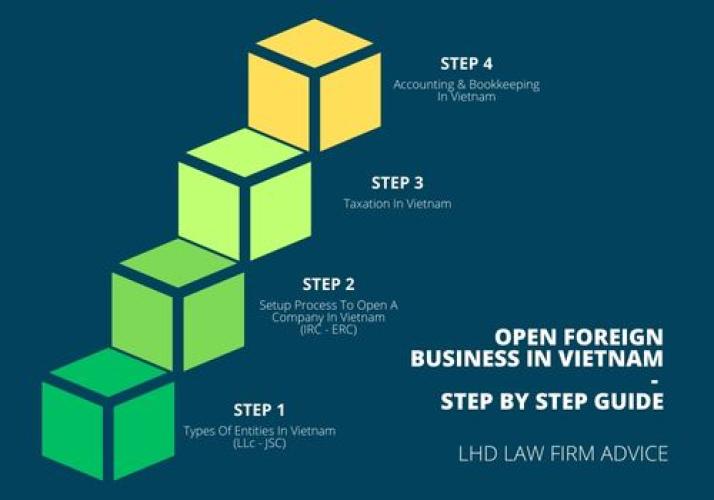
Choosing the right legal structure for your company is a fundamental decision that impacts liability, taxation, and operational flexibility. LHD Law Firm guides clients through the selection of the most appropriate entity based on their specific business goals and risk tolerance. The primary forms of business entities available for foreign investors in Vietnam include:

1. Limited Liability Company (LLC)

The LLC is one of the most popular forms for foreign investors due to its flexibility and limited liability.

  • Structure: An LLC can be wholly foreign-owned or a joint venture with a Vietnamese partner. It can have one or more members (shareholders).
  • Liability: Members' liability is limited to the amount of capital they have contributed to the company.
  • Management: Typically managed by a Director or General Director, who may or may not be a member. A Board of Members oversees major decisions.
  • Capital Requirements: While there are no strict minimum capital requirements mandated by law for most sectors, the contributed capital must be sufficient to cover the business's planned operations and expenses. Investors should register a capital amount that is realistic and justifiable.
  • Advantages: Limited liability protection, relatively straightforward setup, and flexibility in management structure.
  • Considerations: Compliance with reporting requirements and accounting standards is essential.

2. Joint Stock Company (JSC)

JSCs are suitable for larger enterprises, especially those planning to raise capital through public offerings in the future.

  • Structure: A JSC must have at least three founding shareholders. Shares can be offered to the public or privately placed.
  • Liability: Shareholders' liability is limited to the value of their shares.
  • Management: Managed by a Board of Directors, a General Director, and a Supervisory Board.
  • Capital Requirements: Similar to LLCs, there is no statutory minimum capital, but it must be sufficient for operations.
  • Advantages: Easier to raise capital, potential for public listing, and shares are transferable.
  • Considerations: More complex governance structure and stricter regulatory compliance compared to LLCs.

3. Branch Office

A branch office is an extension of a foreign parent company, not a separate legal entity.

  • Structure: Operates under the name and legal responsibility of the parent company.
  • Liability: The parent company is fully liable for the branch's debts and obligations.
  • Activities: Typically limited to specific business activities approved by the authorities, often related to market research, liaison, or representative functions. Manufacturing or direct sales activities are usually not permitted for branches.
  • Advantages: Simpler setup compared to a subsidiary, direct control from the parent company.
  • Considerations: Limited operational scope, full liability for the parent company, and potential tax implications.

4. Representative Office (RO)

An RO is the simplest form of presence for a foreign company in Vietnam.

  • Structure: Cannot engage in direct profit-generating activities. Its primary function is to act as a liaison, conduct market research, and promote the parent company's products or services.
  • Liability: The parent company is responsible for all activities and liabilities of the RO.
  • Activities: Strictly limited to non-revenue-generating activities.
  • Advantages: Easy to establish and maintain, minimal administrative burden.
  • Considerations: Cannot conduct any sales or business transactions, strict reporting requirements.

LHD Law Firm advises clients on the implications of each structure, helping them align their choice with their long-term business strategy.

The Company Formation Process in Vietnam 2026

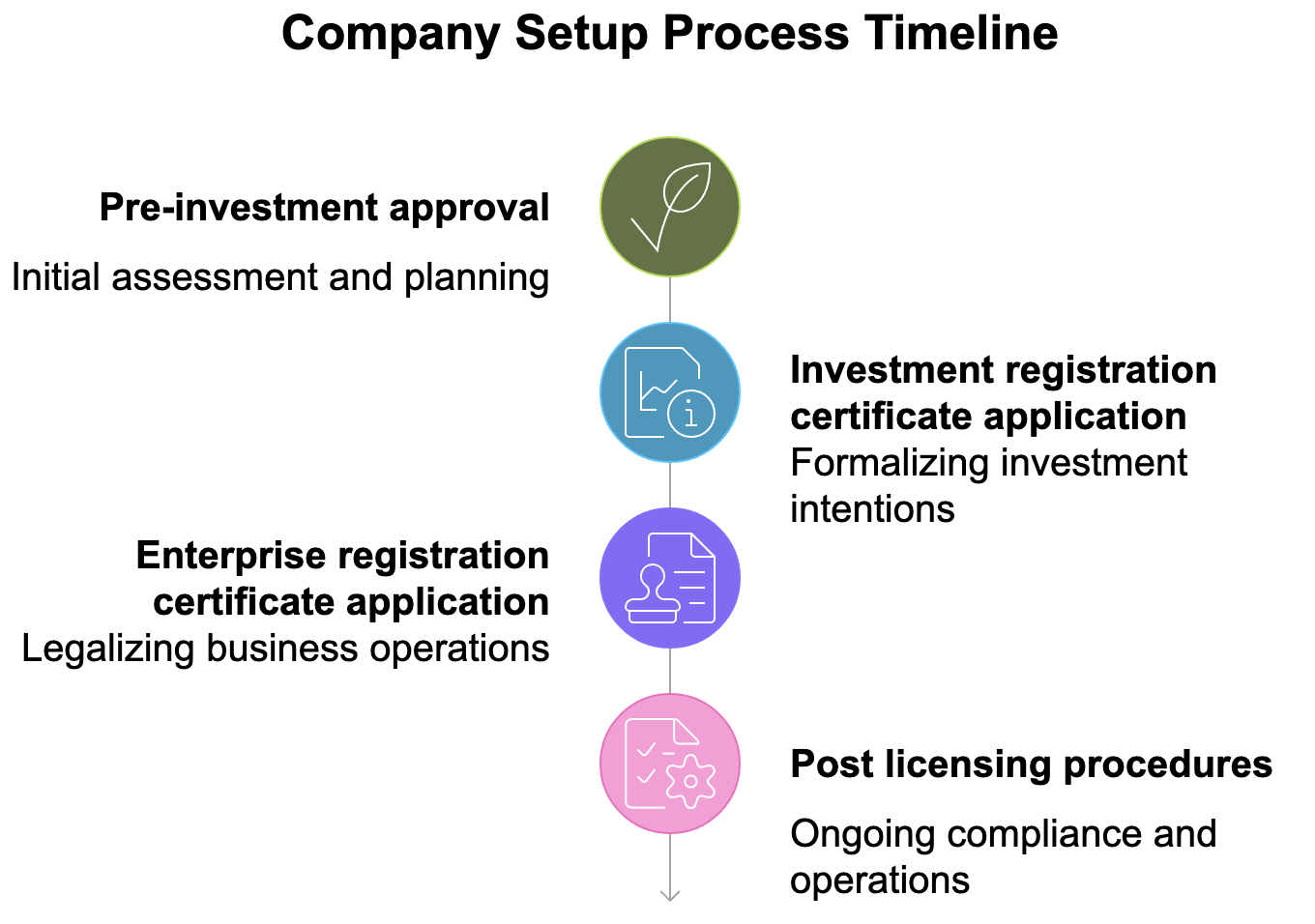
Establishing a company in Vietnam involves several key steps, requiring careful planning and adherence to regulatory procedures. LHD Law Firm breaks down the process into manageable stages:

Step 1: Pre-Investment Approval and Business Registration Certificate (BRC)

This is the foundational step, involving obtaining approval from the relevant authorities.

  • Investment Registration Certificate (IRC): For foreign investors, an IRC is often required, especially for projects falling under specific categories or requiring land use. This certificate outlines the investment project details and ensures compliance with Vietnam's investment laws.
  • Enterprise Registration Certificate (ERC): Once the investment approval is secured (or if not required), the company must apply for an ERC from the Department of Planning and Investment (DPI) in the province or city where the business will be located. The ERC serves as the primary business license.

Step 2: Company Name and Business Lines

  • Company Name: The proposed company name must be unique and adhere to Vietnamese naming conventions. It typically includes the company type (e.g., "Limited Liability Company") and a distinctive name. LHD Law Firm assists in checking name availability and ensuring compliance.
  • Business Lines: The company must clearly define its business activities according to the Vietnamese classification system. These must be approved and will be listed on the ERC.

Step 3: Registered Capital and Shareholder Information

  • Registered Capital: As mentioned, while there's no minimum for many sectors, the capital must be sufficient for operations. The amount declared will be reflected on the ERC.
  • Shareholder Details: Information on all shareholders (individuals or corporate entities), including their identification and capital contribution details, is required.

Every company must appoint at least one legal representative who is authorized to act on behalf of the company. Their personal details and qualifications must be submitted.

Step 5: Obtaining Other Necessary Licenses and Permits

Depending on the industry and specific activities, additional licenses or permits may be required. This can include:

  • Sub-licenses: For specific regulated industries like finance, education, or healthcare.
  • Environmental Permits: For manufacturing or industrial operations.
  • Work Permits: For foreign employees.

LHD Law Firm provides a comprehensive checklist and manages the application process for all necessary permits.

Step 6: Post-Licensing Formalities

After obtaining the ERC and any other required licenses, several administrative tasks must be completed:

  • Seal Engraving: Obtaining official company seals.
  • Opening Bank Accounts: Setting up business bank accounts for capital contributions and operational transactions.
  • Tax Registration: Registering with the local tax authorities.
  • Social Insurance Registration: For employees.
  • Notifying the Public: Announcing the company's establishment on the National Business Registration Portal.

Key Considerations for Foreign Investors

Beyond the procedural steps, foreign investors must be aware of several critical factors:

1. Foreign Ownership Limits (FOLs)

While Vietnam has significantly liberalized its foreign ownership rules, certain sectors may still have restrictions. The Law on Investment outlines specific sectors and their corresponding FOLs. LHD Law Firm stays abreast of these regulations to advise clients on compliance. For many sectors, 100% foreign ownership is permissible.

2. Taxation in Vietnam

Understanding Vietnam's tax regime is crucial for financial planning. Key taxes include:

  • Corporate Income Tax (CIT): The standard CIT rate is 20%, though preferential rates may apply to certain industries or investment projects in specific economic zones.
  • Value Added Tax (VAT): This is a consumption tax levied on goods and services, with rates typically ranging from 0% to 10%.
  • Withholding Tax (WHT): Applicable to payments made to non-residents, such as dividends, interest, royalties, and service fees.
  • Personal Income Tax (PIT): For employees, both Vietnamese and foreign.

Accurate tax compliance and planning are essential. LHD Law Firm offers comprehensive tax advisory services.

3. Labor Law and Human Resources

Vietnam has a well-defined labor code governing employment relationships. Key aspects include:

  • Employment Contracts: Mandatory for all employees.
  • Working Hours and Leave: Regulations on maximum working hours, overtime, annual leave, and public holidays.
  • Social Insurance and Health Insurance: Mandatory contributions for both employers and employees.
  • Foreign Employee Regulations: Requirements for work permits and visas for expatriate staff.

Navigating labor laws ensures fair treatment of employees and compliance with legal obligations.

4. Intellectual Property (IP) Protection

Protecting intellectual property is vital in today's competitive market. Vietnam has laws in place for IP protection, including trademarks, patents, and copyrights. However, enforcement can sometimes be challenging. LHD Law Firm assists clients with IP registration and enforcement strategies.

5. Dispute Resolution

While the goal is always smooth operations, understanding dispute resolution mechanisms is important. Vietnam offers various avenues, including negotiation, mediation, arbitration, and litigation through the Vietnamese court system. International arbitration is also an option for cross-border disputes.

Why Partner with LHD Law Firm for Company Formation in Vietnam?

Navigating the complexities of Vietnam company formation requires specialized knowledge and local expertise. LHD Law Firm offers a comprehensive suite of services designed to ensure a seamless and efficient process for our clients:

Our team comprises experienced lawyers and legal professionals with in-depth knowledge of Vietnamese corporate law, investment regulations, and administrative procedures. We provide tailored advice based on your specific business objectives.

Streamlined Process Management

We manage the entire formation process, from initial consultation and documentation to liaising with government authorities and post-licensing formalities. This allows you to focus on your core business strategy.

Risk Mitigation

We help identify and mitigate potential risks associated with company formation, including compliance issues, ownership restrictions, and contractual challenges. Our proactive approach ensures your business is set up on a solid legal foundation.

Ongoing Support

Our commitment extends beyond company registration. We offer ongoing legal and business advisory services, including contract drafting, labor law compliance, tax advisory, and intellectual property protection, ensuring your business thrives in Vietnam.

Local Market Insight

With years of experience serving both domestic and international clients, we possess valuable insights into the Vietnamese market, enabling us to provide practical and strategic guidance.

Frequently Asked Questions

Here are some common questions regarding company formation in Vietnam:

What are the main types of companies available for foreign investors in Vietnam?

Foreign investors can establish a Limited Liability Company (LLC), a Joint Stock Company (JSC), a Branch Office, or a Representative Office. LLCs and JSCs are the most common choices for establishing a fully operational business entity, offering limited liability to the owners. Branch offices and representative offices have more restricted operational scopes and are extensions of the parent company.

Is there a minimum capital requirement for setting up a company in Vietnam?

For most sectors, Vietnam does not stipulate a statutory minimum registered capital. However, the capital amount must be sufficient to cover the planned business operations and expenses. The registered capital will be stated on the Enterprise Registration Certificate. LHD Law Firm can advise on determining an appropriate capital amount based on your business plan.

How long does the company formation process typically take in Vietnam?

The timeline for company formation can vary depending on the complexity of the business, the industry, and the specific requirements of the provincial authorities. Generally, obtaining the Enterprise Registration Certificate can take between 15 to 30 working days after submitting a complete application. Obtaining an Investment Registration Certificate, if required, can add additional time. LHD Law Firm works diligently to expedite the process.

What are the typical tax obligations for a company operating in Vietnam?

Companies in Vietnam are subject to several taxes, including Corporate Income Tax (CIT), Value Added Tax (VAT), and potentially Withholding Tax (WHT) on payments to foreign entities. There are also personal income tax obligations for employees. The standard CIT rate is 20%, but preferential rates may apply. Understanding these obligations is crucial for financial planning and compliance.

Do foreign employees need work permits to work in Vietnam?

Yes, generally, foreign nationals working in Vietnam, including those in management positions, require work permits. There are certain exemptions, such as for individuals holding specific types of visas or those working for short durations under specific agreements. LHD Law Firm can assist with the work permit and visa application process for expatriate employees.

Every company registered in Vietnam must appoint at least one legal representative. This individual is authorized to act on behalf of the company in all legal and business dealings, including signing contracts, representing the company in legal proceedings, and interacting with government authorities. The legal representative bears significant responsibility for the company's compliance.

Conclusion

Vietnam's economic trajectory and commitment to fostering a conducive business environment make it an increasingly attractive destination for global investors in 2026. From burgeoning tech hubs to robust manufacturing sectors, the opportunities are substantial. However, successfully navigating the intricacies of company formation requires a thorough understanding of the legal framework, administrative procedures, and local market dynamics.

LHD Law Firm stands ready to be your trusted partner in this endeavor. Our expertise in Vietnamese corporate law, coupled with our dedication to client success, ensures that your company formation journey is efficient, compliant, and strategically sound. We are committed to providing the clarity, support, and insights necessary to establish and grow your business in Vietnam.

[1] World Bank. (2026). Vietnam Overview. Retrieved from https://www.worldbank.org/en/country/vietnam [2] European Commission. (n.d.). EU-Vietnam Trade Agreement. Retrieved from https://trade.ec.europa.eu/trade-impact/eu-vietnam-trade-agreement

Many of our clients like us to support their company in Vietnam with office address and company secretary services. If required,
Please kindly contact us with any particular questions you may have.
Contract us:  all@lhdfirm.com 
Written and reviewed by Mrs. Mai Lien

Comment

OUR PARTNERS

SP Group logo
Bgrimmpower
Levanta Renewables
Supercorp
TAF Toyota
Maersk
Yamazen
Beiersdorf.vn
Saigon Co.op
Thyssenkrupp
PKDVN
Ricoh
Fivimart
Wacoal Viet Nam
Sumitomodrive