Vietnamese

Support

📱+842822446739
✉️all@lhdfirm.com

Social

Can a Foreigner Own a Business in Vietnam?

Can a Foreigner Own a Business in Vietnam? A Comprehensive Guide based on Insights from LHD Law Firm. The short answer is yes. Foreigners can legally own and operate businesses in Vietnam. Driven by its rapid economic growth and strategic free trade agreements, Vietnam actively encourages foreign direct investment (FDI).
Table of contents View more
Table of contents

Registering a company in Vietnam as a foreigner - Step-by-step legal guide. You must now

???????? Vietnam is an attractive destination for foreign investors. However, legal procedures can be a significant challenge.

Since the enactment of the Enterprise Law and Investment Law in 2020 (effective 2021), the Vietnamese government has significantly relaxed restrictions, making it easier than ever for international entrepreneurs to enter the market.

Here is a breakdown of what foreign investors need to know about setting up a business in Vietnam.

1. Foreign Ownership Limits: How Much Can You Own?

In many of the most popular sectors—such as IT, management consulting, trading, manufacturing, and education—foreigners are allowed 100% ownership.

However, under Vietnam’s WTO commitments and local laws, certain industries are classified as "conditional" or "restricted."

  • 100% Foreign-Owned: Available for most standard business lines (e.g., retail, software development, consulting).

  • Joint Ventures / Ownership Caps: Some industries require you to partner with a Vietnamese entity or cap your ownership percentage. For example:

    • Banking: Typically capped at 30% foreign ownership.

    • Aviation: Capped at 34%.

    • Logistics/Freight Transport: Often capped at 49% or 51%, depending on the specific service.

    • Advertising: Capped at 99%.

  • Prohibited Sectors: Foreigners cannot invest in debt collection, private investigation, or trades involving endangered species and toxic chemicals.

2. Choosing the Right Business Structure

LHD Law Firm typically recommends that foreign investors choose one of the following legal entities based on their business goals:

A. Limited Liability Company (LLC)

The LLC is the most common and practical choice for small to medium-sized enterprises (SMEs).

  • Structure: Can be established by a single foreign investor (Single-Member LLC) or up to 50 members (Multi-Member LLC).

  • Liability: Founders are only liable for the debts of the business up to the amount of their capital contribution.

  • Control: Offers complete control over the business without the complex administrative requirements of a joint-stock company.

B. Joint Stock Company (JSC)

A JSC is ideal for larger operations or companies planning to go public in the future.

  • Structure: Requires a minimum of three founding shareholders, with no maximum limit.

  • Capital: Capital is divided into equal shares.

  • Flexibility: Highly flexible for raising capital, issuing shares, and transferring ownership.

C. Representative Office (RO)

If you are not ready to conduct commercial operations but want to establish a presence, an RO is the best choice. It allows you to hire staff, conduct market research, and promote your parent company, but it cannot engage in revenue-generating activities.

3. The Step-by-Step Incorporation Process

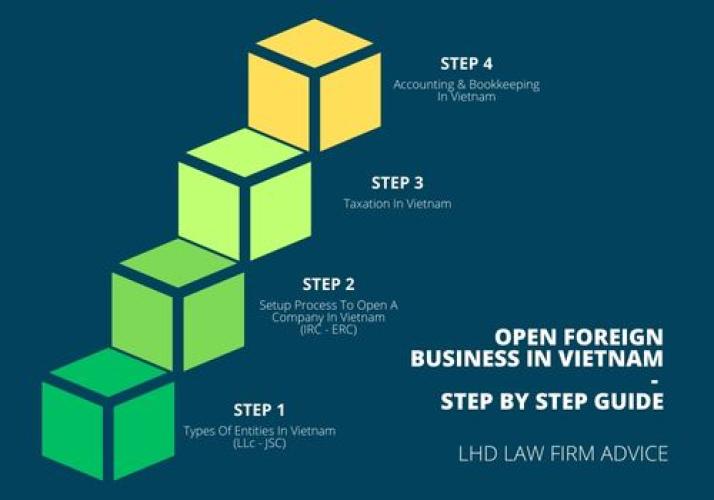
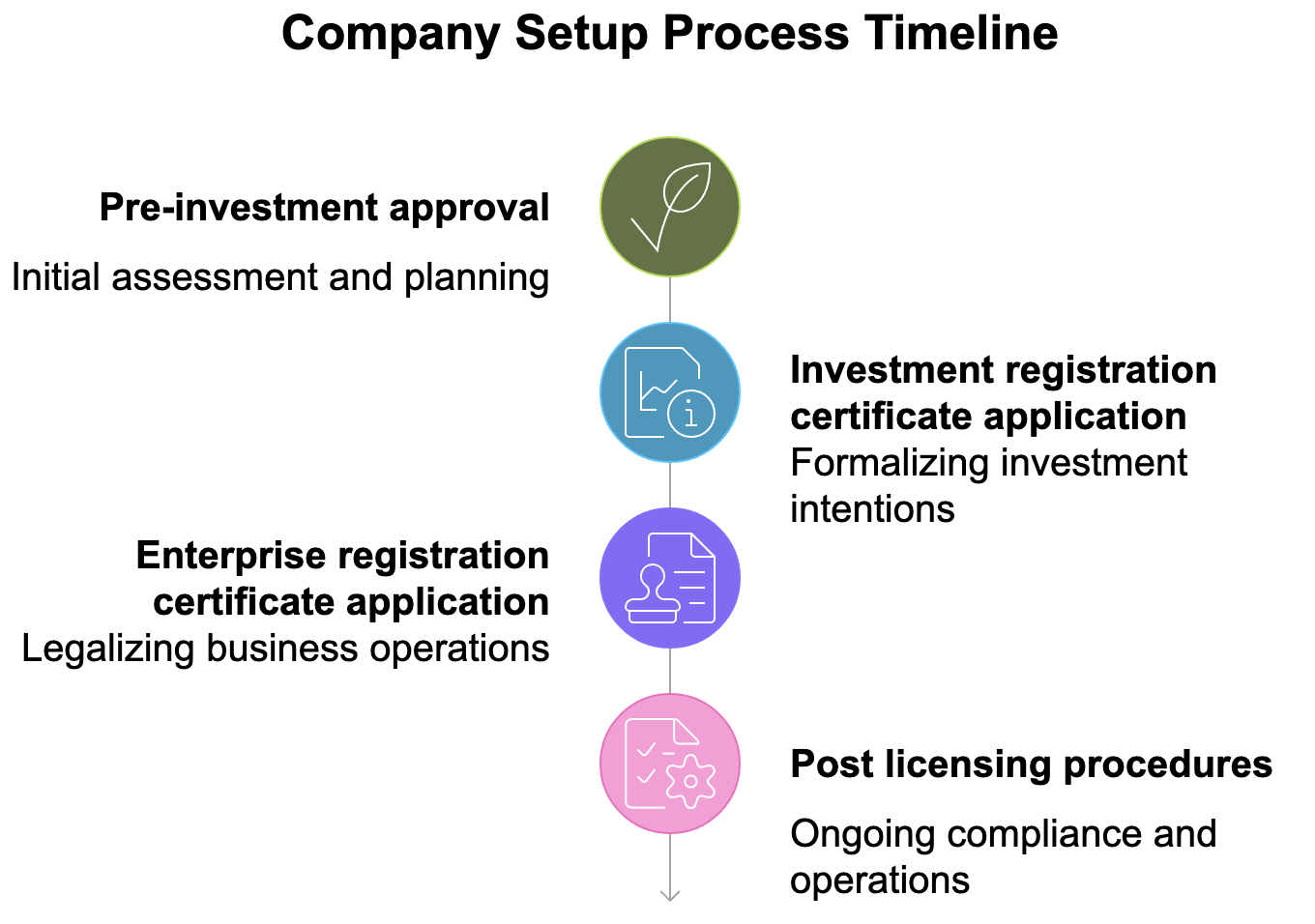
Setting up a 100% foreign-owned enterprise involves a multi-step licensing process. According to LHD Law Firm's framework, the general timeline is 1 to 3 months:

  • Step 1: Investment Registration Certificate (IRC) This certificate approves your specific investment project. You must submit your business plan, proof of financial capacity (bank statements), and lease agreements. It usually takes 15 to 45 working days to process.

  • Step 2: Enterprise Registration Certificate (ERC) Once the IRC is approved, you apply for the ERC, which officially establishes your legal entity and serves as your company's tax identification number. This step is faster, typically taking 3 to 5 working days.

  • Step 3: Sub-Licenses (If Applicable) If your business falls under conditional sectors (e.g., retail, food & beverage, education), you will need to acquire specialised operational licenses from relevant ministries before opening your doors.

4. Crucial Post-Licensing Requirements

Receiving your ERC is not the end of the process. LHD Law Firm highlights several strict post-licensing compliance steps that foreign investors must follow:

  • The 90-Day Capital Rule (Critical): By law, you must transfer your fully registered charter capital into your company’s Direct Investment Capital Account (DICA) within 90 days of receiving your ERC. Failure to do so can result in hefty fines and the revocation of your licenses.

  • Tax Registrations: You must purchase a digital signature token, register for e-invoicing, and pay the initial Business License Tax.

  • Labour & Insurance: If you plan to hire employees, the company must register with the local labour authorities and social insurance agencies.

5. Minimum Capital Requirements

For most standard LLCs, Vietnamese law does not dictate a statutory minimum capital. However, the Department of Planning and Investment (DPI) will assess whether your proposed capital is "sufficient" to cover your business expenses until the company becomes self-sustaining.

As a general rule of thumb for standard service companies, LHD Law Firm (lhdfirm.com) often advises a minimum charter capital of around $10,000 USD (approx. 230-250 million VND) to pass the DPI's feasibility assessment easily.

6. Key notes for foreigners

✅ Conditions on capital ownership and scope of activities (per international commitments).
✅ Foreign documents must be consular legalised and translated into Vietnamese.
✅ Conditional business sectors have more complex requirements.
✅ Capital contribution must be completed on time.
▶️ Legal documents of the investor (individual/organisation)
▶️ Project proposal/Business plan
▶️ Proof of financial capacity
▶️ Office lease agreement
▶️ Application form, Company charter
✅ Post-establishment Requirements: Company seal, bank account, tax registration, capital contribution, sub-licenses (if applicable).
???? The legal process is complex, requiring high accuracy and deep knowledge of Vietnamese law. Partnering with legal experts ensures compliance, saves time and costs, and minimises risks.

Legal Advice | LHD Law Firm

1. Legal advice

  • Review the documents to be prepared
  • After receiving the investment certificate, receive advice on how to obtain the business registration certificate.
  • Advice and application for the Enterprise Certificate (ERC) and the Investment Certificate (IRC)
  • Make a seal
  • Taxes, work permit, TRC
  • Support for the registration of trademarks, designs and inventions when required by businesses (LHD Law Firm is a representative of IP No. 146, the National Office of Intellectual Property, NOIP)
  • Advice on CIT, PIT, and monthly, quarterly and annual tax returns
  • Social insurance consultation, salary calculation (payroll)
  • Consulting for personnel selection in Vietnam
  • Labour law, taxation, and contracts in Vietnam
  • Virtual office rental for companies with foreign capital to provide invoice redemption.

2. Co.op with us

Step 1: Get Legal Advice in English - Vietnamese

Meet with an attorney. We get legal advice on the type of business best suited to your situation.

Step 2: Find office space and legal representation for your business (if there is no available LHD office)

Then find an office space so that your business not only has a place of business but also a specific office address required by the government to apply for a business license. If you are not the legal representative for your business, you need to find a trusted partner.

Step 3: Apply for a business license (IRC, ERC or BL)

Prepare all the necessary documents and make sure that you meet all the requirements before applying for a business license. Expect a 15-day waiting period for a Vietnamese-owned company and a 60-day waiting period for a foreign company.

Step 4: Legal and tax advice for foreign companies after establishment

Running your Vietnamese business now can hire employees and enter into business contracts. There are several things you need to do, such as obtaining your company seal, applying for a tax identification number, opening a company bank account, and publicly announcing your incorporation. Periodic duties include employee tax, accounting report and insurance payments.

(In addition to legal advice, we also provide accounting services for companies with foreign capital for these companies)

3. Why Choose LHD Law Firm

Everything we do at LHD Law Firm is focused on assisting your business through our investment law expertise and local business experience in Vietnam.

So that your enterprise can grow and expand quickly and avoid the costly traps that many start-up investors fall into at the hands of unscrupulous lawyers and agents.

How do we accomplish this?

We offer the best investment legal service in Vietnam, as well as a wide choice of INDIVIDUAL AND ECONOMIC EFFECTIVE SOLUTIONS for starting a business in Vietnam or managing an existing one.

  • What we can do ...
Consulting on the establishment of foreign-owned companies in Vietnam, consulting on the establishment of Vietnamese factories and consulting on industrial production, sourcing Vietnam, supporting business registration, accounting, and tax compliance through information intelligence, low-cost operational setup, HR & admin, government liaison services, director services, country representation/management services for M&A, and much more...contact us at: ☑: all@lhdfirm.com
Written and reviewed by Ms. Nguyen Ngan Phuc

Comment

OUR PARTNERS

SP Group logo
Bgrimmpower
Levanta Renewables
Supercorp
TAF Toyota
Maersk
Yamazen
Beiersdorf.vn
Saigon Co.op
Thyssenkrupp
PKDVN
Ricoh
Fivimart
Wacoal Viet Nam
Sumitomodrive