Vietnamese

Support

📱+842822446739
✉️all@lhdfirm.com

Social

Vietnam Company Registration: Steps, Costs, and Requirements Explained (2026 Guide)

Learn the complete Vietnam company registration process in 2026, including legal requirements, setup costs, timelines, licenses, and foreign investment procedures with LHD Law Firm.
Table of contents View more
Table of contents

Vietnam remains one of Southeast Asia’s most attractive destinations for foreign investors due to its strategic location, competitive labor costs, expanding consumer market, and strong manufacturing ecosystem. However, understanding the legal process for company registration in Vietnam is essential before entering the market.

This guide explains the complete Vietnam company registration process, including legal requirements, setup costs, timelines, licenses, and common compliance obligations for foreign investors.

Why Foreign Investors Choose Vietnam

Foreign direct investment (FDI) in Vietnam continues to grow because the country offers:

  • Access to ASEAN and major global trade agreements
  • Competitive operational costs
  • Rapidly growing middle-class consumption
  • Strong manufacturing and technology sectors
  • Increasing digitalization of business registration procedures

Vietnam allows foreign investors to establish companies in many sectors with ownership ranging from partial to 100%, depending on industry restrictions.

Types of Business Entities in Vietnam

Before registering a company, investors must choose the appropriate legal structure.

1. Wholly Foreign-Owned Company (WFOE)

A wholly foreign-owned enterprise allows foreign investors to maintain full ownership and operational control. This is the most common structure for international SMEs and service businesses.

Suitable for:

  • Consulting firms
  • IT companies
  • Trading businesses
  • Manufacturing operations
  • E-commerce companies

2. Joint Venture Company (JV)

A joint venture involves cooperation with a Vietnamese partner. This structure may be required in sectors with foreign ownership restrictions.

Suitable for:

  • Education
  • Logistics
  • Advertising
  • Certain distribution sectors

3. Representative Office (RO)

A representative office cannot conduct direct revenue-generating activities. It is mainly used for:

  • Market research
  • Liaison activities
  • Brand promotion

Representative offices generally have faster setup timelines than full foreign-invested enterprises.

Vietnam Company Registration Process

The registration process depends on whether the business is domestic or foreign-invested.

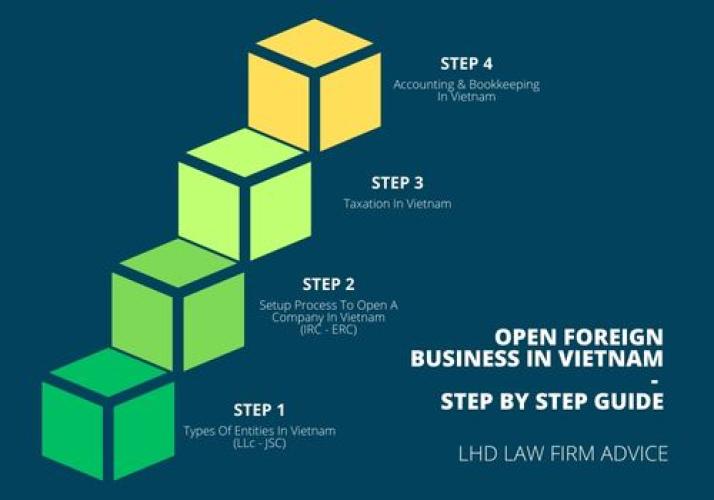
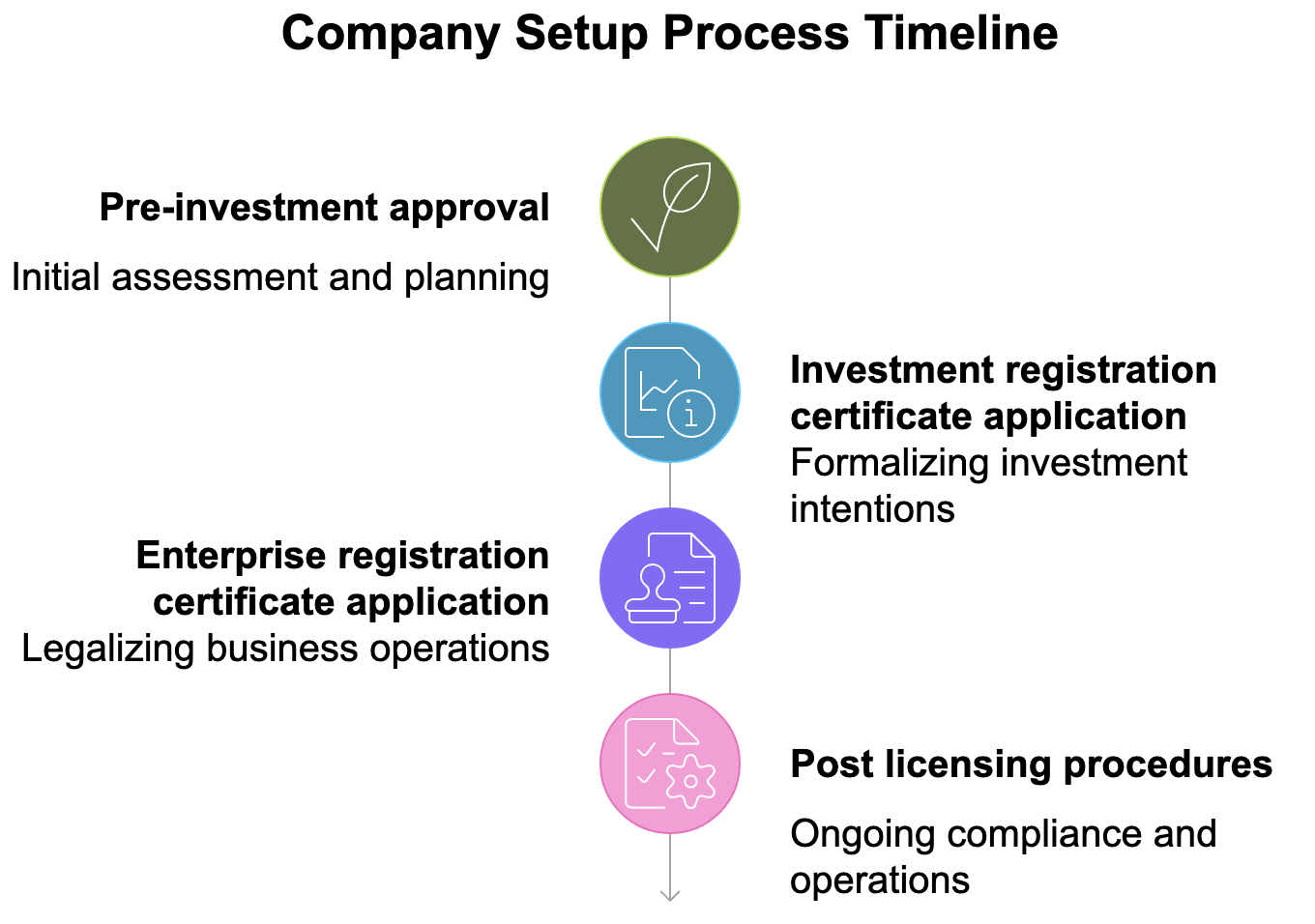
For foreign investors, the process usually includes two major licenses:

  1. Investment Registration Certificate (IRC)
  2. Enterprise Registration Certificate (ERC)

Step 1: Choose Business Activities

Investors must identify:

  • Business sectors
  • Foreign ownership restrictions
  • Licensing conditions
  • WTO market access commitments

Certain sectors require:

  • Vietnamese partners
  • Additional ministry approvals
  • Specialized permits

Conditional sectors often face longer approval timelines.

Step 2: Secure a Legal Business Address

Every company in Vietnam must have a registered office address.

Requirements:

  • Commercial-use address
  • Proper lease agreement
  • Compliance with zoning regulations

Residential apartments are generally not accepted for business registration purposes.

Step 3: Prepare Required Documents

For Individual Foreign Investors

Common documents include:

  • Passport copy
  • Bank statement or financial proof
  • Office lease agreement
  • Business plan
  • Power of attorney (if using a service provider)

For Corporate Investors

Additional documents may include:

  • Certificate of incorporation
  • Company charter
  • Board resolution
  • Appointment of authorized representatives

Foreign corporate documents normally require:

  • Notarization
  • Consular legalization
  • Vietnamese translation

Step 4: Apply for Investment Registration Certificate (IRC)

The IRC is typically required for foreign-invested projects in Vietnam.

The IRC application includes:

  • Investment objectives
  • Capital structure
  • Project timeline
  • Financial capacity
  • Office location

Authorities may request clarification on:

  • Business scope
  • Investment capital
  • Ownership structure
  • Commercial feasibility

Official review periods are often around 15 working days, but real-world timelines are usually longer.

Step 5: Obtain Enterprise Registration Certificate (ERC)

The ERC officially establishes the company as a legal entity in Vietnam.

The ERC includes:

  • Company name
  • Enterprise code
  • Registered address
  • Charter capital
  • Legal representative
  • Business activities

After ERC issuance, the company can:

  • Open bank accounts
  • Sign contracts
  • Hire employees
  • Begin operational setup

Step 6: Complete Post-Licensing Procedures

After registration, businesses must complete several compliance steps:

Common Post-Licensing Tasks

  • Tax registration
  • Company seal creation
  • Opening capital bank accounts
  • Capital contribution
  • E-invoice registration
  • Labor registration
  • Social insurance setup
  • Accounting compliance

Foreign-invested companies must also comply with periodic reporting obligations.

Vietnam Company Registration Costs

The total cost depends on:

  • Business sector
  • Company structure
  • Licensing complexity
  • Foreign ownership conditions
  • Legal advisory services

Government Fees

Official state registration fees are relatively low.

For example:

  • Business registration disclosure fee: approximately 100,000 VND

Online registration may exempt certain filing fees.

Practical Setup Costs

Most foreign investors should budget for:

  • Legal advisory fees
  • Translation and notarization
  • Consular legalization
  • Office lease deposits
  • Accounting setup
  • Compliance services

Complex or regulated sectors usually require higher professional support costs.

Minimum Capital Requirements

Vietnam generally does not impose fixed minimum capital requirements for many sectors. However, authorities expect “reasonable” charter capital based on:

  • Business activities
  • Operational scale
  • Staffing plans
  • Office expenses

Some industries may impose statutory minimum capital requirements.

Authorities increasingly review:

  • Financial capability
  • Funding source legitimacy
  • Capital contribution schedules

How Long Does Company Registration Take?

Typical timelines:

Process Estimated Timeline
Representative Office 2–4 weeks
Standard FDI Company 4–8 weeks
Conditional Business Sectors 2–4 months

Delays often result from:

  • Incomplete documents
  • Incorrect business scopes
  • Ownership restrictions
  • Weak financial documentation

Key Legal Requirements for Foreign Investors

Foreign investors should pay close attention to:

Market Access Restrictions

Some sectors:

  • Limit foreign ownership
  • Require local partnerships
  • Require ministry approvals

Resident Legal Representative

Vietnamese companies must appoint at least one legal representative.

Beneficial Ownership Transparency

Recent reforms increasingly emphasize disclosure of ownership structures and compliance oversight.

Electronic Authentication Rules

As of July 2025, certain business registration authorizations require electronic authentication procedures.

Common Mistakes Foreign Investors Make

Choosing Incorrect Business Lines

Improper business activity registration can delay approvals or create future compliance risks.

Underestimating Capital Requirements

Low charter capital may trigger licensing concerns or operational limitations.

Using Non-Compliant Office Addresses

Improper office leases frequently delay IRC approvals.

Ignoring Post-Licensing Compliance

Many companies focus only on incorporation while overlooking:

  • Tax filings
  • Accounting obligations
  • Labor compliance
  • Annual reporting

Final Thoughts

Vietnam offers strong long-term opportunities for foreign investors, but company registration requires careful planning and regulatory compliance.

A successful setup strategy should include:

  • Correct business structure selection
  • Proper licensing preparation
  • Accurate documentation
  • Realistic capital planning
  • Ongoing compliance management

For foreign investors entering Vietnam in 2026, understanding both the legal framework and practical implementation process is critical for smooth market entry and sustainable growth.

LHD Law Firm is a Vietnam-based legal and investment consulting firm providing services for foreign investors, international companies, and domestic enterprises. The firm operates offices in Ho Chi Minh City, Hanoi, and Da Nang.

Main Legal Services

LHD Law Firm provides advisory services in areas such as:

  • Foreign investment consulting
  • Vietnam company registration
  • M&A and corporate restructuring
  • Tax and accounting advisory
  • Intellectual property and trademark registration
  • Work permits and visas
  • Contract drafting and review
  • Litigation and dispute resolution
  • Real estate and construction law
  • Labor and employment law

The firm focuses heavily on assisting foreign investors entering the Vietnamese market.

Office Locations

LHD Law Firm

Cambodian
  • Address: HP Tower, Floor 7, 60 Nguyen Van Thu Street, Tan Dinh Ward
  • Phone: +84 28 2244 6739
  • Email: all@lhdfirm.com

LHD Law Firm

Cambodian
  • Address: Anh Minh Tower, Floor 4, 36 Hoang Cau Street, O Cho Dua Ward
  • Phone: +84 24 2261 2929
  • Email: hanoi@lhdfirm.com

LHD Law Firm

Cambodian
  • Address: 71 Ly Tu Trong Street, Thach Thang Ward
  • Phone: +84 905 987 929
  • Email: danang@lhdfirm.com

Legal Experience and Background

According to company information and public profiles, LHD Law Firm has operated since approximately 2007–2012 and advises on thousands of foreign investment and company setup projects in Vietnam. Public information also references legal practice in English and Vietnamese for international clients.

Written and reviewed by Mrs. Nguyen Phuong Khanh

Comment

OUR PARTNERS

SP Group logo
Bgrimmpower
Levanta Renewables
Supercorp
TAF Toyota
Maersk
Yamazen
Beiersdorf.vn
Saigon Co.op
Thyssenkrupp
PKDVN
Ricoh
Fivimart
Wacoal Viet Nam
Sumitomodrive