Vietnamese

Support

📱+842822446739
✉️all@lhdfirm.com

Social

Setting Up a Company in Vietnam

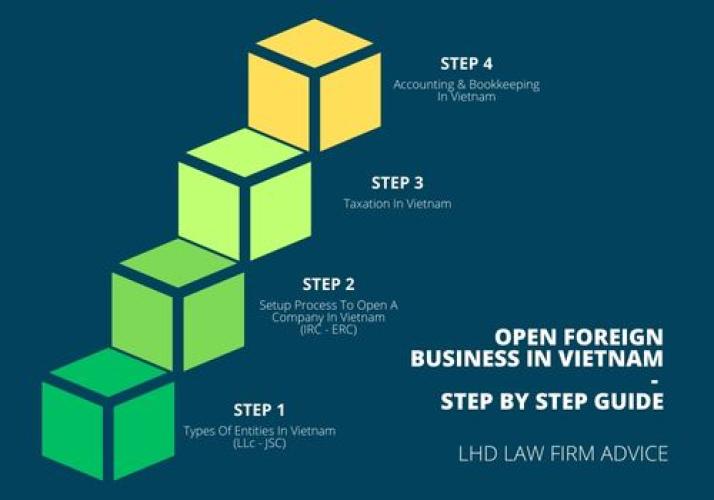
Setting Up a Company in Vietnam: foreign investors can generally own 100% of most business sectors; start by securing an Investment Registration Certificate (IRC), then an Enterprise Registration Certificate (ERC), and expect regulatory updates under the revised Law on Investment, effective 1 March 2026.
Table of contents View more
Table of contents

Overview — quick checklist

  • Decide structure: LLC (LLP), 100% foreign-owned company, joint venture, branch, or representative office.

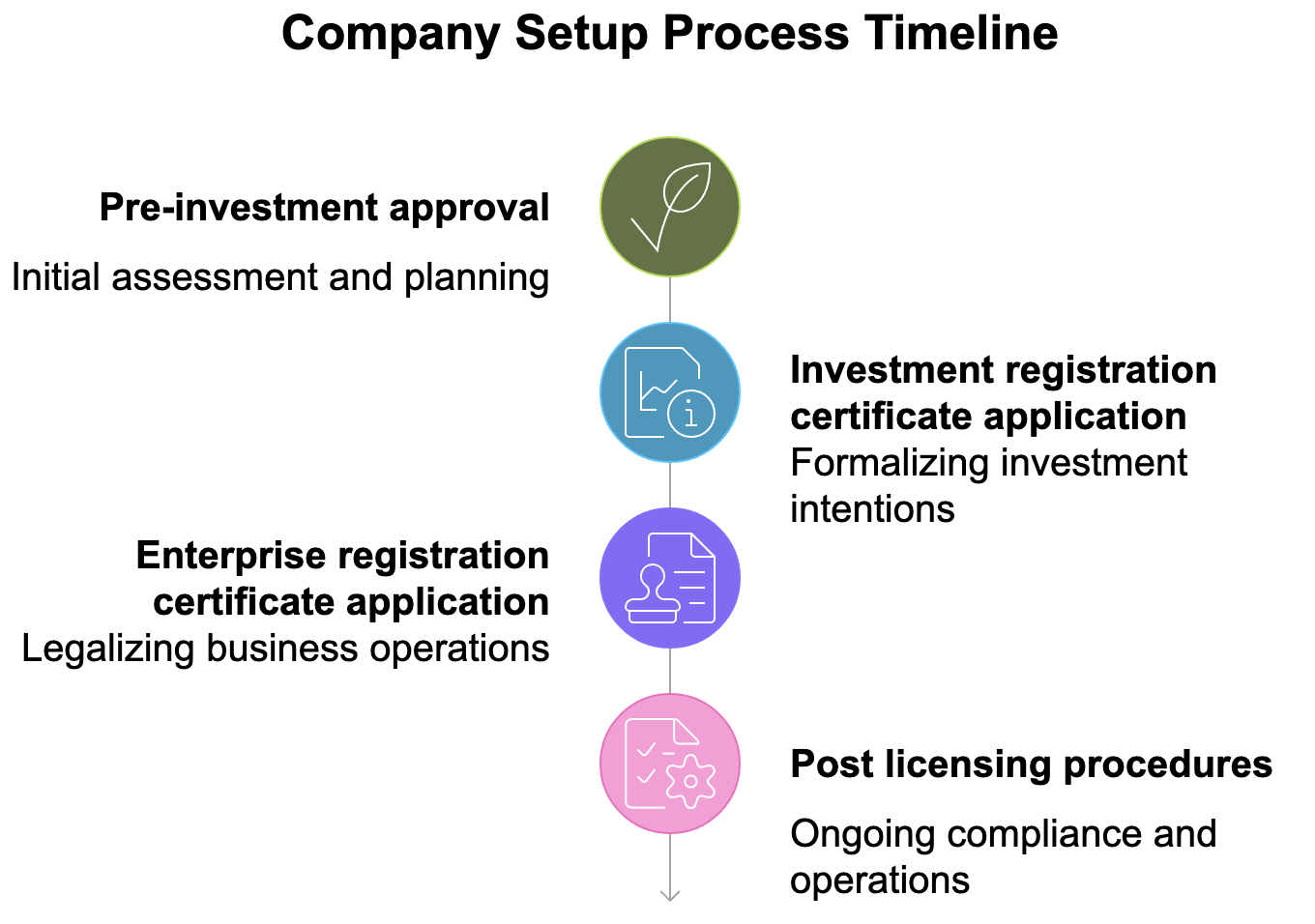
  • Key approvals: Investment Registration Certificate (IRC) (if FDI) → Enterprise Registration Certificate (ERC) → tax code & social insurance registration → bank account & capital contribution.
  • Timing: typical incorporation 4–8 weeks, depending on sector and completeness of documents.

Entity comparison (at-a-glance)

Entity type Foreign ownership Control Use case Regulatory steps
Limited Liability Company (LLC) Up to 100% High Local operations, trading, services IRC (if FDI); ERC; tax; bank.
Joint Venture Shared Shared Local partner advantages Investment approval, ERC; shareholder agreements.
Representative Office N/A (no trading) Limited Market research, liaison Registration with MOIT; limited activities.
Branch Same as parent Parent-controlled Foreign company extension Branch license; tax registration.

The "ERC-First" Breakthrough: A Step-by-Step Guide

The most significant change in 2026 is the ability for select "non-sensitive" sectors to apply for their Enterprise Registration Certificate (ERC) before their Investment Registration Certificate (IRC). This allows you to secure your Tax ID and legal status in weeks.

Step 1: Market Access & Negative List Check

Before spending a cent, we must check Decree 96/2026/ND-CP. If your sector is "unrestricted," you are treated like a local investor. If it’s "conditional," you must meet specific capital or licensing requirements.

Step 2: The IRC (Investment Registration Certificate)

For traditional FDI projects, this is your "project license." It outlines:

  • Total investment capital vs. Charter capital.

  • Project duration (usually 50 years, extendable to 70 in industrial zones).

  • Location (a valid lease agreement or Memo of Understanding is mandatory).

Step 3: The ERC (Enterprise Registration Certificate)

This is your "birth certificate." Once issued, you have a Tax ID and a legal persona.

  • Timeline: 3–5 working days post-IRC.

  • 2026 Requirement: At least one Legal Representative must reside in Vietnam to manage the mandatory digital signature (Chữ ký số).

Step 4: Post-Licensing & The 90-Day Rule

The clock starts the moment your ERC is issued.

  • Capital Contribution: You have exactly 90 days to inject your charter capital into the DICA (Direct Investment Capital Account). Failure to do so results in heavy fines and potential license revocation.

  • Public Announcement: You must publish your registration on the National Portal.

  • Seal & Signage: Order your company seal and hang your sign. Yes, physical signs are still a legal requirement in 2026.


Taxation: The 2026 Fiscal Reality

Vietnam’s tax system is transitioning to a "Post-Inspection" (Hậu Kiểm) model. The government lets you operate freely but punishes non-compliance during annual audits.

Corporate Income Tax (CIT)

The standard rate is 20%. However, 2026 offers aggressive incentives for:

  • High-Tech & Semiconductors: 10% for 15 years, with 4 years of tax holiday.

  • Green Economy: Projects involving circular economy models (Decision 687/QD-TTg) receive significant land-rent exemptions.

Value Added Tax (VAT)

Standard rate is 10%. In 2026, the threshold for non-cash payments has been lowered to 5 million VND. Any expense above this paid in cash is not tax-deductible.


Protecting Your Assets: The Copyright Holder's Perspective

As a professional copyright holder, this is where I get passionate. In May 2026, Vietnam launched its largest-ever National IP Enforcement Campaign (Official Telegram No. 38/CĐ-TTg). This is a direct response to Vietnam being named a "Priority Foreign Country" by the USTR.

What This Means For You:

  1. Software Licensing: If your company uses unlicensed software, you are at high risk of a raid this month.

  2. The 2025 IP Law: It introduces a "Fast-track" for trademarks and patents. If you are a tech firm, register your IP before you register your company.

  3. Digital Platform Liability: If your business operates a platform (e-commerce, SaaS), you are now legally responsible for the IP infringements of your users under the new "Safe Harbor" rules.

Recent regulatory change to note

  • Revised Law on Investment (effective 1 March 2026) emphasises quality screening of foreign investors and tighter ongoing supervision; plan for enhanced disclosure and compliance expectations.

Risks, traps, and lawyerly tips

  • Do not assume sector openness — always verify the current conditional list before committing funds.

  • Local approvals vary by province — timelines and additional requirements can differ; use a local legal representative in Ho Chi Minh City to speed processing.

  • Protect IP and contracts — draft shareholder agreements, IP assignments, and exit clauses in Vietnamese and English.

  • Tax planning — register VAT and corporate income tax early; noncompliance triggers fines and delays.

Next steps (recommended)

  • Book a consultation with LHD Law Firm to review your business plan, confirm sector eligibility, and prepare IRC/ERC filings.

  • Gather corporate documents and an English‑Vietnamese set of contracts for immediate submission.

If you’d like, I can draft a tailored incorporation checklist for your specific industry and investment size and estimate a realistic timeline for Ho Chi Minh City.

Why choose LHD Law Firm

  • Local experience since 2007, recognised in Vietnam legal directories and with a track record advising foreign investors on company formation, M&A and compliance.

  • End‑to‑end service: from pre‑investment screening and IRC/ERC filings to tax registration, employment compliance and dispute prevention.

Common Pitfalls: The "Lawyer’s Grave"

Having seen hundreds of companies fail before they even start, avoid these 2026 traps:

  • The "Nominee" Trap: Using a local "friend" to hold 100% of the shares to bypass foreign restrictions. In 2026, the authorities have advanced data-matching tools to spot "hidden" FDI. If caught, your assets can be frozen.

  • Incorrect DICA Flow: Capital must flow from the investor's overseas account into the DICA, and then into the operating account. Any deviation makes it impossible to repatriate profits later.

  • Lease Validity: Ensure your landlord has the legal right to lease. If the building doesn't have a Construction Permit or a Fire Safety Certificate, your IRC application will be rejected.

Written and reviewed by Mrs. Nguyen Phuong Khanh

Comment

OUR PARTNERS

SP Group logo
Bgrimmpower
Levanta Renewables
Supercorp
TAF Toyota
Maersk
Yamazen
Beiersdorf.vn
Saigon Co.op
Thyssenkrupp
PKDVN
Ricoh
Fivimart
Wacoal Viet Nam
Sumitomodrive