Vietnamese

Support

📱+842822446739
✉️all@lhdfirm.com

Social

Opening a Business in Vietnam as a Foreigner: The 2026 LHD Law Firm Guide

Planning to open a business in Vietnam? Read the 2026 ultimate guide for foreign investors. LHD Law Firm provides a Legal, Honest, Defensive market entry.
Table of contents View more
Table of contents

Opening a Business in Vietnam as a Foreigner: The 2026 Ultimate Guide

  • The biggest mistake foreign investors make when entering Vietnam? Misunderstanding the 90-day charter capital rule and local corporate E-ID mandates.
  • Setting up an LLC or JSC in Vietnam is highly lucrative, but regulatory missteps during the initial Investment Registration Certificate (IRC) phase can lead to severe operational delays. At LHD Law Firm, we protect our clients’ investments before they even sign a lease.
  • Our new 2026 Ultimate Guide breaks down the exact compliance requirements, tax obligations, and legal representative rules you need to know. Build your business on a Legal, Honest, Defensive foundation.

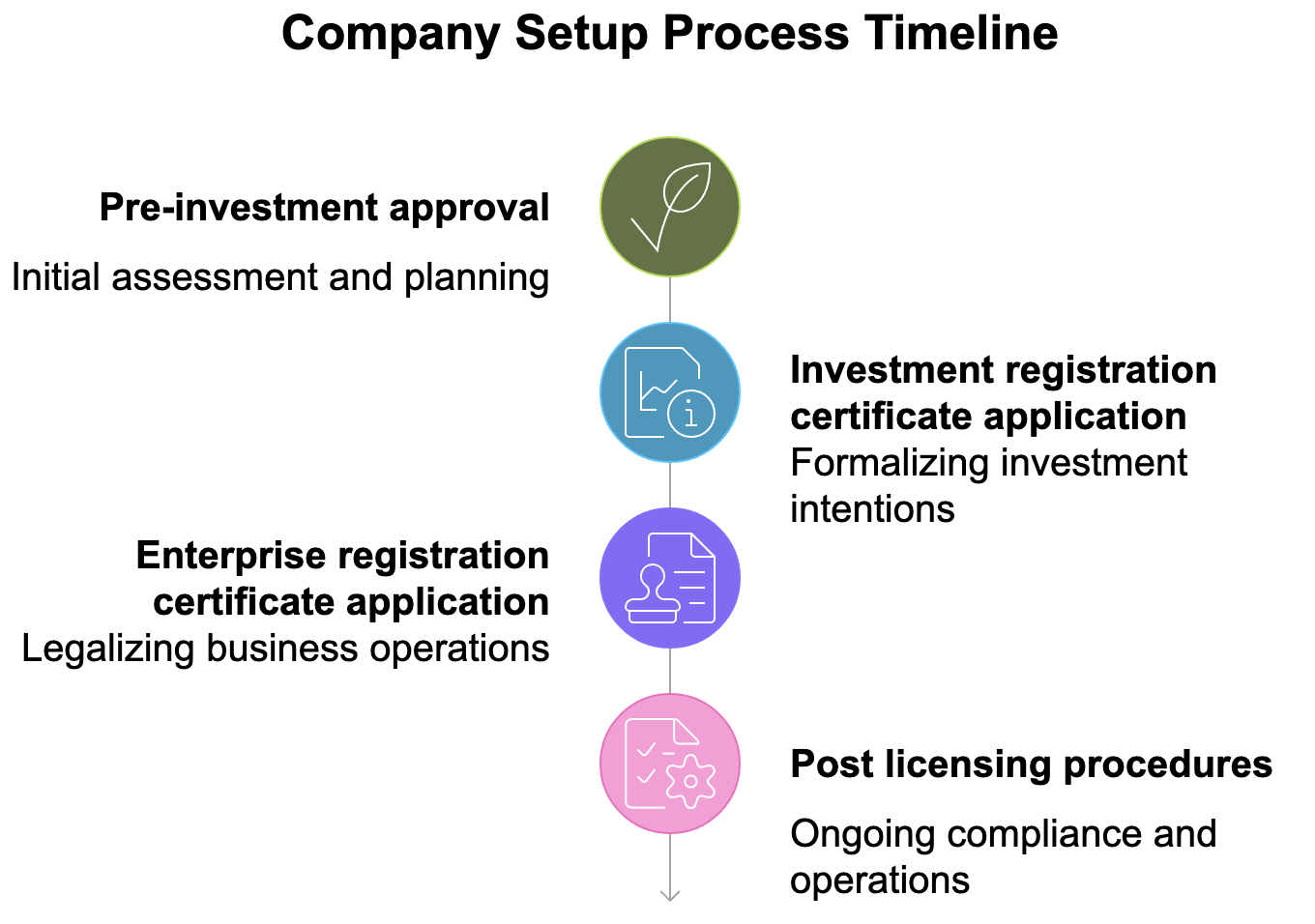
1. Pre-investment Approval

Before filing any paperwork, foreign investors must understand the foundational rules of corporate ownership and capitalisation in Vietnam.

  • Foreign Ownership Limits: Under World Trade Organisation (WTO) commitments and local investment laws, foreigners can own up to 100% of a business in most sectors, including manufacturing, IT, and trading. Some conditional sectors, like tourism or logistics, may require a joint venture with a Vietnamese partner.

  • Minimum Capital Requirements: For most standard business lines, there is no statutory minimum capital. However, the Department of Planning and Investment (DPI) will assess your stated charter capital to ensure it is logically sufficient to support your business operations until the company becomes self-sustaining.

  • The 90-Day Rule: Once your company is officially registered, the stated charter capital must be fully contributed within 90 days. Failure to meet this strict deadline can result in heavy financial penalties and jeopardise your entire investment license.

2. Choosing a corporate structure

There are several types of foreign-invested corporate vehicles in Vietnam; the 3 more common of these are:

Comparison of Business Structures

RO

Representative Office

BO

Branch Office

LLC

100% Foreign-Owned Enterprise

No

No

Yes

Extension of the parent company

Extension of the parent company

Liability limited to capital contribution.

Must be the same as the parent company

Must be the same as the parent company

Can be the same or different from the parent company


Only market research and coordination.

No business activities that yield profit.


Commercial activity within the parent company’s scope

Can be the same or different from the parent company

6 to 8 weeks

12 weeks

8 to 16 weeks


No.


Companies are required to declare all employees’ Personal Income Tax (read about PIT).


Yes

Yes

Yes. RO is required to file an annual RO's activities Report prepared by itself to be submitted to the licensing authority, not through an independent auditing firm.

Yes

Yes

Easy registration procedure

Can remit profits abroad

·    Limited liability to capital contribution

·    Freely engage in any registered business lines that are not banned by local laws

  • Cannot conduct revenue-generating activities
  • Parent company bears liability
  • Limited to certain industry sectors
  • Parent company bears liability
  • Cannot issue shares
  • Maximum of 50 shareholders
  • A foreign investor can choose to establish a joint stock company in Vietnam.

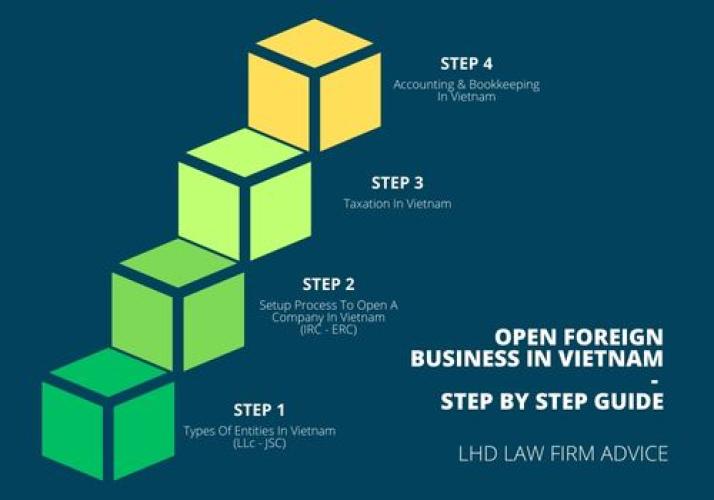
3. The Step-by-Step Company Setup Process

Establishing a Foreign-Invested Enterprise (FIE) in Vietnam involves navigating several provincial and national government departments. 

Step 1: Secure an Operational Address

Before incorporating, you must have a valid registered address. For manufacturing, logistics, or retail, a physical commercial location is strictly required. For consulting or IT services, leasing a compliant virtual office is often acceptable, depending on the local DPI's discretion.

Step 2: The Investment Registration Certificate (IRC)

The IRC is the primary license for foreign investors, proving your right to execute a specific investment project in Vietnam.

  • Processing Time: Typically 15 to 30 days.

  • Key Focus: The authorities evaluate your financial capacity, business plan, and the project's economic viability.

Step 3: The Enterprise Registration Certificate (ERC)

Once the IRC is granted, you apply for the ERC, which formally incorporates the company and generates your unified Tax Identification Number (TIN).

  • Processing Time: 3 to 7 working days.

  • Compliance Note: Under mandates implemented in mid-2025, corporate entities must also register for their Corporate E-ID, integrating digital compliance directly into the standard establishment process.

4. Post-Licensing & Financial Compliance

Receiving your ERC is not the end of the journey; it is the beginning of your operational compliance. A defensive legal strategy means getting these immediate next steps right.

  1. Make a company seal. Sealmaker Company's seal is required by law and in practice to open a bank account. The company obtains a company seal from a seal-maker. The company has the right to decide on the design, content and quantity of its seal and can have several seals with the same design and content
  2. Submit an online notification of the seal-sample Agency: Business Registration Office. Entrepreneurs must submit an online notification of the seal-sample to the Business Registration Office. At the time of receiving the notification, the BRO sends the entrepreneur a receipt. According to Article 34 of Decree 78/2015/ND-CP, a company has the right to decide the effective date of the seal.
  3. Open a bank account, Agency: Bank. Each bank requires a different minimum deposit to open an account. For instance, whereas Vietcombank requires the fixed amount of VND 1 million for an account in VND and USD 300 for one in USD, Asian Commercial Bank requires VND 1 million for a VND account and US 100 for a USD account. To open the account, the bank requires a bank-issued application form, a copy of the notification on use of the seal with a confirmation stamp of the Business Registration Office, the Charter of the Company, the Enterprise Registration Certificate (ERC) and relevant documents as required by each bank. A bank account is required in practice to pay taxes.
  4. Approve pre-printed VAT invoices with the Municipal Taxation Department Agency: Municipal Taxation Department Companies shall use self-printed or purchased VAT invoices or electronic VAT invoices. Electronic VAT regulation is not mandatory, and the majority of companies opt for the traditional VAT system. The applicant must contact a publisher to order the printing of VAT Invoice Books and must register the self-printed invoices with the Municipal Taxation Department. To register for self-printing of invoices, company founders must submit an application on a standard form, along with (a) a sample self-printed invoice, including all statutory details; (b) a map showing the location of the company’s office or copy of the lease contract if the premises are leased, certified by the ward commune people’s committee; (c) the general director’s identification card; (d) a copy of the business registration certificate; and (e) and the tax registration certificate and copy. In total, it takes about 10 days to obtain the self-printed VAT invoices and have them registered with the Municipal Taxation Department.
  5. Pay business license tax Agency: Tax office or commercial bank. The business license tax must be paid to the tax authority where the enterprise registers its tax reports or through designated commercial banks. This license tax is paid annually and in the first month of the year (concerning enterprises that are operating) and in the month when the newly established enterprise obtains the tax code. A new company established during the first 6 months of the year shall pay the entire annual business license tax. If it was established during the last 6 months, it must pay 50% of the annual license tax. According to Article 4 of Circular 302/2016/TT-BTC, the business license tax depends on the charter capital of the enterprise as follows: - An enterprise with charter capital above VND 10 billion: VND 3,000,000 per year; - An enterprise with charter capital of VND 10 billion or less: VND 2,000,000 per year; - Branches, representative offices, business locations, business units, other economic organisations: VND 1,000,000 per year. The entrepreneur can transfer the licensing tax through a commercial bank with form C1-02/NS enclosed to Circular 302/2016/TT-BTC
  6. Register with the local labour office to declare use of the labour agency: Municipal Department for Labour, Invalids and Social Affairs. Within 30 days of starting operations, employers must register all employees and their qualifications with the Labour Office (in conformity with set forms). The relationship between the employer and its employees is regulated by the Labour Code and outlined in labour contracts.
  7. Register employees with the Social Insurance Fund for the payment of health insurance and social insurance Agency: Social Insurance Fund The company must register employees with the Social Insurance Fund. The employer must complete a form provided by the Social Insurance Fund and include the following information: the employee name and date of birth, salary (as stated in the labor contract), the social insurance book serial number (for employees already issued with those books), a certified copy of the company's business registration certificate, and a copy of each labor contract. The Social Insurance Office must, within 30 days from the date of receipt of the application file, issue an insurance registration book for each new employee who was not issued such a book by the previous employer. The employer is responsible for paying social and health insurance contributions for each employee. Since the health insurance merged with the social insurance funds, payment is made (monthly or quarterly) directly to the Social Insurance Fund. Health insurance certificates are issued during the first month of the year.

5. The Legal Representative and Work Permits

Every company in Vietnam must have at least one Legal Representative (LR). This individual is legally accountable for the company's actions and signs all official documents.

  • Residency: At least one Legal Representative must reside in Vietnam. If they leave the country for an extended period, they must authorise another resident in writing to act on their behalf.

  • Work Permits: If the Legal Representative is a foreign national, they must obtain a valid Vietnamese work permit. Capital-contributing founding members or owners of an LLC with a capital contribution above a specific threshold (typically over 3 billion VND) may apply for a work permit exemption, but standard directors and managers must undergo the full application process.

    Final Thoughts: Securing Your Investment

Opening a business in Vietnam as a foreigner requires more than just filling out forms; it requires a strategic partner who understands how the laws intersect with your specific business goals. By prioritising a Legal, Honest, Defensive approach to corporate structuring, tax planning, and labour compliance, you safeguard your enterprise against unforeseen liabilities and position it for sustainable, long-term growth in one of Southeast Asia's most dynamic markets.

6. Key notes for foreigners

✅ Conditions on capital ownership and scope of activities (per international commitments).
✅ Foreign documents must be consular legalised and translated into Vietnamese.
✅ Conditional business sectors have more complex requirements.
✅ Capital contribution must be completed on time.
▶️ Legal documents of the investor (individual/organisation)
▶️ Project proposal/Business plan
▶️ Proof of financial capacity
▶️ Office lease agreement
▶️ Application form, Company charter
✅ Post-establishment Requirements: Company seal, bank account, tax registration, capital contribution, sub-licenses (if applicable).
???? The legal process is complex, requiring high accuracy and deep knowledge of Vietnamese law. Partnering with legal experts ensures compliance, saves time and costs, and minimises risks.
 

Legal Advice | LHD Law Firm

1. Legal advice

  • Review the documents to be prepared
  • After receiving the investment certificate, receive advice on how to obtain the business registration certificate.
  • Advice and application for the Enterprise Certificate (ERC) and the Investment Certificate (IRC)
  • Make a seal
  • Taxes, work permit, TRC
  • Support for the registration of trademarks, designs and inventions when required by businesses (LHD Law Firm is a representative of IP No. 146, the National Office of Intellectual Property, NOIP)
  • Advice on CIT, PIT, and monthly, quarterly and annual tax returns
  • Social insurance consultation, salary calculation (payroll)
  • Consulting for personnel selection in Vietnam
  • Labour law, taxation, and contracts in Vietnam
  • Virtual office rental for companies with foreign capital to provide invoice redemption.

2. Co.op with us

Step 1: Get Legal Advice in English - Vietnamese

Meet with an attorney. We get legal advice on the type of business best suited to your situation.

Step 2: Find office space and legal representation for your business (if there is no available LHD office)

Then find an office space so that your business not only has a place of business but also a specific office address required by the government to apply for a business license. If you are not the legal representative for your business, you need to find a trusted partner.

Step 3: Apply for a business license (IRC, ERC or BL)

Prepare all the necessary documents and make sure that you meet all the requirements before applying for a business license. Expect a 15-day waiting period for a Vietnamese-owned company and a 60-day waiting period for a foreign company.

Step 4: Legal and tax advice for foreign companies after establishment

Running your Vietnamese business now can hire employees and enter into business contracts. There are several things you need to do, such as obtaining your company seal, applying for a tax identification number, opening a company bank account, and publicly announcing your incorporation. Periodic duties include employee tax, accounting reports, and insurance payments.

(In addition to legal advice, we also provide accounting services for companies with foreign capital for these companies)

3. Why Choose LHD Law Firm

Everything we do at LHD Law Firm is focused on assisting your business through our investment law expertise and local business experience in Vietnam.

So that your enterprise can grow and expand quickly and avoid the costly traps that many start-up investors fall into at the hands of unscrupulous lawyers and agents.

How do we accomplish this?

We offer the best investment legal service in Vietnam, as well as a wide choice of INDIVIDUAL AND ECONOMIC EFFECTIVE SOLUTIONS for starting a business in Vietnam or managing an existing one.

  • What we can do ...
Consulting on the establishment of foreign-owned companies in Vietnam, consulting on the establishment of Vietnamese factories and consulting on industrial production, sourcing Vietnam, supporting business registration, accounting, and tax compliance through information intelligence, low-cost operational setup, HR & admin, government liaison services, director services, country representation/management services for M&A, and much more...contact us at: ☑: all@lhdfirm.com
Written and reviewed by Mrs. Nguyen Huong Quynh Thao

Comment

OUR PARTNERS

SP Group logo
Bgrimmpower
Levanta Renewables
Supercorp
TAF Toyota
Maersk
Yamazen
Beiersdorf.vn
Saigon Co.op
Thyssenkrupp
PKDVN
Ricoh
Fivimart
Wacoal Viet Nam
Sumitomodrive