Vietnam is one of the fastest-growing economies in the world. The low cost of living and highly qualified population make it an ideal location for foreign companies who are looking to branch out and invest. However, expanding internationally has its disadvantages as well. Not knowing the local laws and regulations makes it a thousand times harder to open a company overseas.
Vietnam has become one of Southeast Asia’s most attractive destinations for foreign investors. With its strategic location, rich labor pool, improving infrastructure, and increasingly trade-friendly policies, many companies are choosing to open foreign company in Vietnam as a key part of their regional expansion.
Below is everything you need to know — laws, steps, timelines, and tips — to make sure you can establish your foreign-owned entity smoothly and compliantly.
A “foreign company” generally refers to a business entity in Vietnam in which foreign individuals or organizations hold ownership or control. It could be:
A 100% foreign-owned company (commonly a wholly foreign-owned LLC or JSC).
A joint venture with Vietnamese or other foreign partners.
Foreign branches or representative offices (though these often have limitations in scope of operations).
Foreign participation is permitted in many sectors, but not all. Some industries are prohibited outright, while others are conditional (requiring licensure, minimum capital, or local partner involvement). The choice of legal form (LLC, Joint Stock Company, etc.) depends on business style, capital needs, governance preferences, and growth plans.
Key legal foundations:
Law on Investment 2020: Regulates foreign investment, including what sectors are open, conditions, investor eligibility, and registration certificates.
Law on Enterprises: Governs business entities, their structure, internal governance, rights & obligations of shareholders, etc.
Decree 31/2021/ND-CP (and other guiding decrees/circulars): flesh out procedures (how to apply, what documents, etc.).
Authorities you’ll deal with:
Department of / Ministry of Planning & Investment (DPI / MPI) — for issuing Investment Registration Certificate (IRC).
Business Registration Office (part of DPI / provincial level) — for Enterprise Registration Certificate (ERC).
Tax Authorities, sector-specific regulators (health, education, trade, environment, etc.) — depending on business scope.
Before applying, check:
Whether your industry is prohibited or restricted for foreign investment. Article 6 of the Investment Law and international treaties matter.
If conditional, whether you meet extra criteria (capital, licenses, foreign ownership caps, credentials).
Foreign ownership ceilings: Some sectors limit foreign ownership to 49% or lower, or require local partner share
You will need:
Investor identity documents: e.g., passport (for natural persons), or incorporation / registration documents (for legal persons).
Investment plan or project proposal: purpose, scale, investment capital, location, timeline, outcomes.
Proof of financial capability: showing you can fulfill capital commitments.
Business address: valid lease or premises rights. Serviced or shared offices may be acceptable if zoning and lease acceptable.
Legal representative: someone resident and acceptable under law.
Others if required: land use rights, Environmental Impact Assessment (EIA), planning approval or zoning, depending on sector or location
Needed before ERC for foreign investors in most cases.
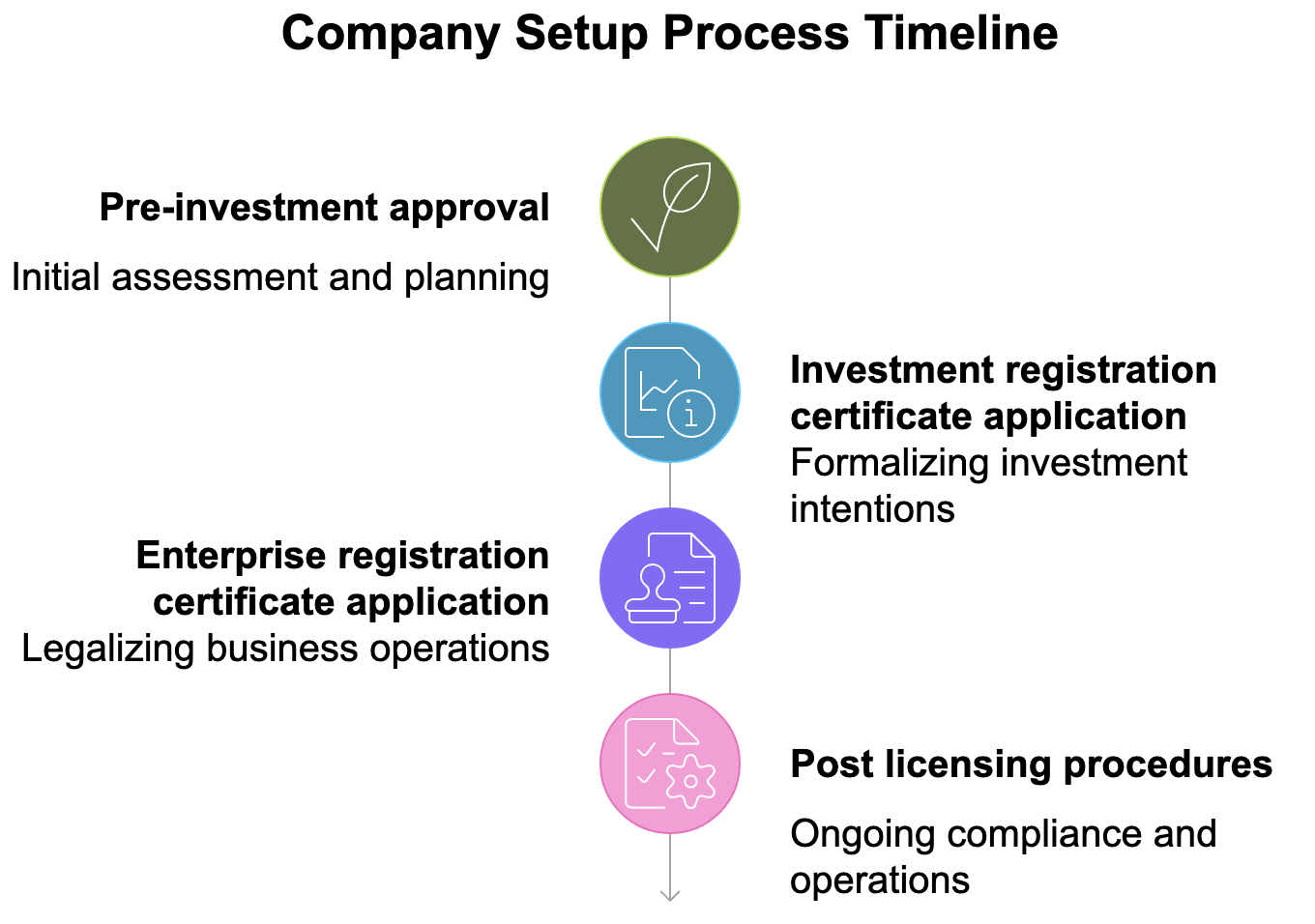
Issued by the DPI / MPI. You submit the investment project, documents, etc.
Processing time often ~ 15-20 working days, though conditional sectors may take longer.
Once IRC is granted (if needed), you apply for ERC to get legal entity status.
Must supply charter, details of capital, business scope, address, shareholders etc. https://lhdfirm.com/+1
If your business activity is not among those requiring foreign investment registration, or you establish a company structure which is exempt. But many foreign-owned entities will require IRC. Laws clearly define when IRC is mandatory.
Here is a typical workflow:
Decide legal form & ownership structure
Choose between LLC (one-member or multi-member), JSC, joint venture, branch, etc. Decide if wholly foreign-owned or shared.
Secure business address & legal representative
Get a valid business address and appoint someone (could be foreigner with visa or local) as legal representative.
Prepare documents
Collect investor documents, project plan, financial proof, address proof, etc. Translate / notarize / legalize as required.
Obtain IRC (if required)
Submit application to DPI / MPI. Wait for the decision.
Obtain ERC
Once IRC is granted, apply for enterprise registration.
Make company seal
After ERC is issued, have the official seal (company stamp) made, and register the sample seal with authorities.
Open bank accounts
Investment capital account (for bringing in foreign capital)
Operational account in VND for regular business transactions
Register for tax & other compliance
Tax code, VAT (if applicable), corporate income tax, personal income tax withholding, social insurance, etc.
Obtain special licenses / permits if your business is in a regulated sector.
Start operations once all formalities are complete.
| Scenario | Time | Key Cost Items |
|---|---|---|
| Non-conditional sector (e.g. service, trading) | ~ 4-6 weeks once documents are fully prepared and all sector rules satisfied | Registration fees (IRC + ERC), translation / notarization, seal, legal counsel, address lease, bank account setup |
| Conditional sector or sectors needing special permits (e.g. healthcare, education, finance, real estate) | 8-12 weeks or more (could be 2-3 months+) depending on approvals required | Additional licensing fees, environmental / land / planning fees, possibly higher capital requirements, longer legal fees |
Costs depend heavily on city (Hanoi, Ho Chi Minh City, Da Nang cheaper or more expensive), scale, sector, legal counsel, etc. Budget for not only the obvious fees but also translations, legal advice, unexpected compliance costs.
Registered capital: the amount you declare in company charter. It must be realistic and sufficient for your planned operations and business scope. There is no universal minimum, but conditional sectors may impose specific thresholds.
Investment capital: amount committed by foreign investor which may need to be transferred into Vietnam under the capital account. Must prove financial origin.
Some sectors require minimum capital by law (e.g., real estate, banking, education) to ensure competence.
Contribution deadlines: often required that capital is contributed within a defined period (e.g. 12 months) after IRC issuance.
Tax registration: once you have ERC, register with tax authorities, obtain tax code. Start VAT, CIT & PIT compliance.
Accounting & auditing: maintain books in Vietnamese dong, prepare annual financial statements, often audits required especially for foreign-invested companies.
Labor & social insurance: if you hire employees, you must register for social insurance, health insurance etc.
Licenses & permits: depending on your business, additional licenses may be required (environment, signage, food safety, trade permits etc.).
The legal representative may require a visa/residence permit depending on nationality.
Foreign staff will need valid visas (LD, or work-visa), and work permits depending on job scope.
Temporary Resident Card (TRC) is often used for longer stays.
Criminal record checks, health checks may be required.
Vietnam offers various incentives to foreign investors:
Tax holidays or reduced corporate tax rates in certain sectors or locations.
Customs duty exemptions or reductions on imported equipment.
Preferential treatment in Special Economic Zones or Industrial Parks.
Provincial / city level incentives may also apply, depending on where you locate.
Delays due to incomplete or improperly translated documents. Always get good translations and legal reviews.
Declaring business scope too broadly (causing difficulty later) or too narrowly (restricting growth).
Choosing an office address that isn’t acceptable (residential vs commercial zoning etc.).
Under-estimating cost or time. Conditional sectors especially cause unexpected delays.
Skipping legal counsel. Foreign investment law, licensing, incentives, and tax treatment are complex and vary by city / province.
Example: Setting up a 100% foreign-owned LLC in Ho Chi Minh City, non-conditional service business (consultancy).
| Task | Approx Time | Estimated Cost |
|---|---|---|
| Decide Company Type & Ownership, prepare charter & investor docs | 1 week | Legal/translation: USD 500-1,000 |
| Secure business address & appoint legal representative | 1 week | Lease + documentation: variable (USD 300-800) |
| Apply for IRC | ~15 working days | Government fee + counsel cost: USD 1,000-2,000 |
| Apply for ERC | ~5-7 working days | Government fee + minor counsel cost: USD 500-1,000 |
| Seal engraving, open bank accounts | 1 week | Seal cost + bank fees: USD 200-500 |
| Tax registration, regulatory compliance | 1-2 weeks | Accounting setup, tax adviser: USD 500-1,500 |
Total time: ~ 4-6 weeks
Total startup cost (excluding rent, staff, operations): could be in range USD 3,000-7,000 depending on service provider, scale, and legal complexity.
Do I always need an Investment Registration Certificate (IRC)?
In most cases for foreign investors, yes. If you are setting up a foreign-owned company or an enterprise with majority foreign ownership, you’ll need IRC before you can apply for the Enterprise Registration Certificate (ERC). Some narrow exemptions exist depending on sector and company structure.
Can I use a virtual office address to register my company?
Possibly, but it depends. The address must be valid, commercial-zoned, and properly documented (lease or ownership). Purely virtual or residential addresses are often rejected by authorities. Maison Office+1
How long does it take to open a foreign company in Vietnam?
For non-conditional sectors with well-prepared documents: about 4-6 weeks. For businesses in conditional / regulated sectors, expect 8-12 weeks or more. Delays may come from licensing, environmental approvals, or foreign ownership restrictions.
Is there a minimum capital requirement?
There is no universal minimum for most foreign-owned companies in non-conditional sectors. However, in certain industries (e.g. real estate, finance, healthcare, education), specific minimum capital thresholds are required. Also, the registered capital must be realistic relative to the business plan. Công ty Luật TNHH Lexconsult & Cộng sự+1
What are the tax obligations after incorporation?
You will need to register for a corporate income tax (CIT), value-added tax (VAT) if applicable, and personal income tax (PIT) for employees. Accounting books must be maintained, financial statements prepared annually, and audits may be required. Also, social insurance and labor contributions for staff.
Can I hire foreigners and get work permits/residence through the company?
Yes. Foreign staff can obtain work permits / relevant visas. The company must satisfy requirements (capital, legal structure) and provide job contracts, sometimes educational or professional credentials. Residence permits (TRC) can be obtained for longer stays.
Meet with an attorney. We get legal advice on the type of business best suited to your situation.
Then find an office space so that your business not only has a place of business but also a specific office address required by the government to apply for a business license. If you are not the legal representative for your business, you need to find a trusted partner.
Prepare all the necessary documents and make sure that you meet all the necessary requirements before applying for a business license. Expect a 15-day waiting period for a Vietnamese-owned company and a 60-day waiting period for a foreign company.
Running your Vietnamese business now can hire employees and enter into business contracts. There are several things you need to do, such as obtaining your company seal, applying for a tax identification number, opening a company bank account, and publicly announcing your incorporation. Periodic duties include employee tax, accounting report and insurance payments.
(In addition to legal advice, we also provide accounting services for companies with foreign capital for these companies)
Everything we do at LHD Law Firm is focused on assisting your business through our investment law expertise and local business experience in Vietnam.
So that your enterprise can grow and expand quickly and avoid the costly traps that many start-up investors fall into at the hands of unscrupulous lawyers and agents.
? How we accomplish this?
We offer the best investment legal service in Vietnam, as well as a wide choice of INDIVIDUAL AND ECONOMIC EFFECTIVE SOLUTIONS for starting a business in Vietnam or managing an existing one.
© 2025 LHD Law Firm

Comment