Vietnam is one of the fastest-growing economies in the world. The low cost of living and highly qualified population make it an ideal location for foreign companies who are looking to branch out and invest. However, expanding internationally has its disadvantages as well. Not knowing the local laws and regulations makes it a thousand times harder to open a company overseas.
Vietnam is a potential destination for foreign investors due to its political stability, abundant human resources, and low labour costs. Over the past 5 years, FDI inflows into Vietnam have increased dramatically. The company registration process in Vietnam is quite simple, but there are specific instructions for foreign-owned businesses. In this article, the experts of LHD Law Firm will share with you how to register a company in Vietnam.
Foreign investors who want to register a company in Vietnam must ensure the following conditions:
Business owners can set up a Vietnamese company with 100% foreign capital in almost any industry: commerce, information technology, manufacturing, and education.
However, some industries still have limited foreign ownership, such as advertising, logistics, and tourism. In this case, foreign investors will need a Vietnamese joint venture partner.
There is no specific regulation on any minimum capital in Vietnam for most business lines. However, it must be enough to cover the company's costs during its establishment. Most businesses set a minimum capital of 10,000 USD. The Department of Planning and Investment will assess whether your capital contribution is appropriate for the business line.
However, some business lines still require minimum capital, including: Foreign language Centre, Skills School, Real estate company, Bank, Insurance, Finance and Fintech.
Investors need a business address to set up a company in Vietnam. Service firms such as consulting firms may use virtual office addresses. Most manufacturing companies, restaurants, retail trade, etc., must have a physical location or office.
The Department of Planning and Investment may check your address during your company registration. You can submit documents as proof of your address.
Foreigners who are looking to register a company in Vietnam must have at least one legal representative residing locally, possibly a resident director. He or she is not required to have a status of residence at the time of incorporation. However, they must have a residential address in Vietnam.
If the director is also the founder, he or she will not need a work permit. Instead, the person will have to apply for a work permit exemption. If the director of the company is a foreigner and is not the founder of the company, he will need a work permit in Vietnam.
In case the company wants to appoint another legal representative who is a foreigner who has not yet resided in Vietnam, they must come to Vietnam to apply for a work permit. The appointed foreign legal representative also needs to have at least 1 year of experience in a management position.
The Vietnamese government allows foreign investors to choose one of the following business types when registering a company in Vietnam: Limited liability company (single member or multiple members), Joint Stock Company, Partnership, Branch Office, and Representative Office.
It's the most common form of company formation for foreign investors. There are two types of liability companies: single-member limited liability companies and multi-member limited liability companies.
For a single-member limited liability company, there is only one member. For a multi-member limited liability company, at least 2 members are required, up to a maximum of 50 members. The responsibility of the members revolves around being responsible for the amount of their contributed capital.
The advantages of registering a limited liability company in Vietnam include: the ability to decide all issues related to business activities, simple management, cost savings and control over the change of members. Small and medium enterprises (SMEs) should choose this category.
Disadvantages of a Limited Liability Company include: it is not allowed to list on the Vietnam Stock Exchange while the founders are not allowed to issue shares to the public; members of a limited liability company may not reduce their charter capital during the operation period; it is more difficult for the company to gain trust from partners and customers than a joint stock company due to its low charter capital.
A joint stock company is the only business type that can issue corporate bonds in Vietnam and is allowed to be listed on the Vietnam stock exchange.
The minimum number of shareholders of a joint stock company is 03 people. There is no limit to the maximum number of shareholders. The member's responsibility revolves around being responsible for the amount of their/contributed capital.
The structure of a joint stock company is ideal for medium and large businesses, as it requires a minimum of 3 founders to set up. This type of enterprise has the advantage of high capital mobilisation ability, the ability to operate in different business fields, and is allowed to freely transfer shares.
However, this type of business has some disadvantages, such as: The procedure for registering a company takes a lot of time and costs; financial, accounting, as well as internal legal issues are strictly managed by the state; The control, monitoring and management are relatively complicated.
A partnership is a formal arrangement of 2 or more general partners to run a business and share profits. General partners are liable to the extent of their overall personal assets. General partners may transfer part or all of their shares with the consent of other general partners.
A partnership offers several advantages, such as ease of trust and connection between the company and its partners and customers due to unlimited liability in the scope of all assets. Reputation is also often associated with partnerships.
However, establishing a partnership means being liable to the extent of all assets, which can pose a huge risk to the partners. The company is also not allowed to issue securities to raise capital.
Foreign companies can choose to set up a branch office in Vietnam. This type of company operates under the same structure as the partial expansion of the parent company in Vietnam. The owner of a multinational branch in Vietnam is allowed to conduct business activities, make and register profits, without establishing an external legal entity.
The condition to open a branch office in Vietnam is foreign company must be established and conduct business activities for at least 5 years outside of Vietnam. The branch office in Vietnam must appoint a resident representative, file annual tax returns and submit audited financial statements.
The Vietnamese branch will not be recognised as a separate legal entity from the parent company. When transferring profits from the branch to the parent company, the profits will not be tax-deductible.
Foreign companies established outside of Vietnam can choose to set up a representative office in Vietnam.
However, this type has many limitations. Foreign companies registered as Representative Offices are not allowed to generate income on behalf of the company. The representative director or legal representative can sign documents on behalf of the foreign company if that person is authorised. This business type is prohibited from conducting income-generating business activities. Therefore, it is often selected by companies that only have the goal of observing the local market before fully expanding.
Business owners may choose to establish a representative office if their primary purpose is to conduct market research and promote the parent company's activities.
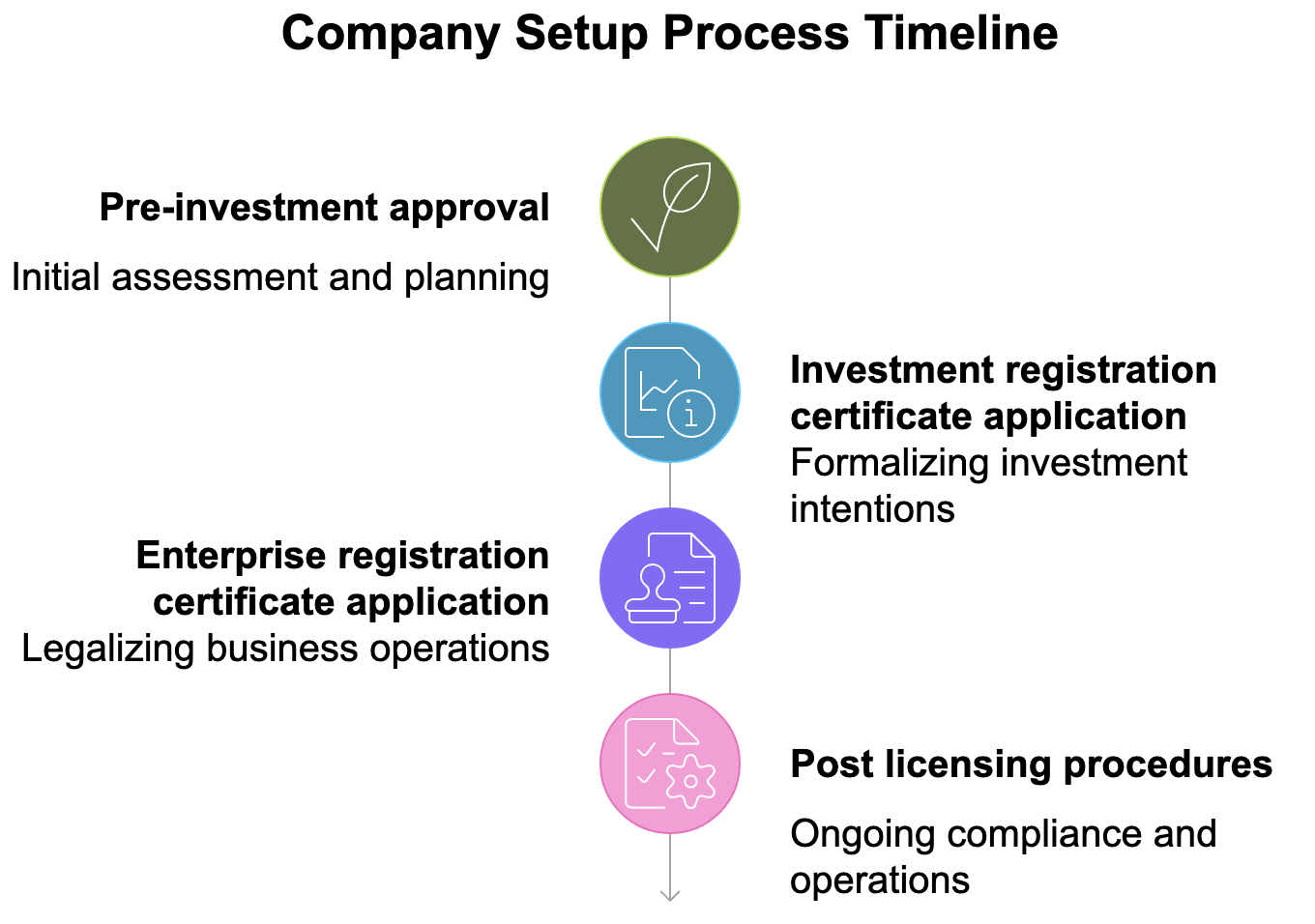
To register a company with foreign capital in Vietnam, you need an investment registration certificate. The Department of Planning and Investment is responsible for issuing this certificate. It usually takes about a month to receive the certificate.
Authority to issue Investment Registration Certificate:
Documents to be prepared to apply for an Investment Registration Certificate
Procedures for registration of Investment Registration Certificate
Investors must register to declare online information about investment projects on the National Information System on Foreign Investment.
Within 15 days from the time the investor has submitted the online application, the investor shall apply for the Investment Registration Certificate to the Investment Registration Authority.
After receiving the application, the investor will be given an online account to access the National Information System on Foreign Investment to monitor the processing and results of the application.
In case of successful issuance of the Investment Registration Certificate, the investment registration authority shall issue a code through this account to the investment project; In case the application is rejected, this agency must notify the investor in writing and clearly explain the reason.
Companies in Vietnam must also have a Business Registration Certificate (BRC) or an Enterprise Registration Certificate (ERC). The Department of Planning and Investment is responsible for issuing this certificate.
Documents to be prepared to apply for a Business Registration Certificate:
Procedures for applying for a Certificate of Business Registration
You must apply to the Business Registration Office via the National Business Registration Portal within 03 - 05 days.
The Business Registration Authority will issue the Business Registration Certificate.
After being granted an Enterprise Registration Certificate, you must make a public announcement on the National Business Registration Portal according to the order and procedures within 30 days from the time of publication.
For companies that retail goods or set up retail establishments:
Retailing is the sale of goods to individuals, households, other individuals, and organisations for consumption. Therefore, investors are not required to issue business licenses for export, import, and wholesale goods (not in the commodity groups: lubricants, rice, sugar; video articles; books; newspapers). , Journal). Investors issue business licenses when retailing goods and setting up goods in retail establishments.
For international travel companies (inbound):
Foreign investors are only allowed to conduct international travel business within the scope of bringing foreign tourists into Vietnam.
For foreign language training companies:
The investor must obtain the approval of the Department of Education and Training during the process of granting the Investment Registration Certificate. Before going into operation, enterprises must apply for a license to operate a foreign language training centre at the Department of Education and Training.
The business registration certificate number is also the tax code of the company. Companies must pay taxes through an online system. Companies also file tax returns and reports through this system. To be granted access to this system, businesses must have a digital signature.
After receiving the BRC, you have 90 days to make the capital contribution. Failure to do so will result in a fine.
Depending on the line of business, some companies need to apply for a sub-license or additional business license.
Occupations that require a sub-license: Manufacturing, logistics, recruitment, and accommodation.
Cases where additional business licenses are required: Companies selling or distributing cosmetics
Corporate compliance in Vietnam includes the following:
Consulting on company registration in Vietnam for foreign investors is the professional consulting field of LHD Firm. Over 15 years of work, we have completed legal work on more than 6,800 projects for businesses and individuals from 32 countries around the world.
By providing you with The Best Investment Legal Service and a wide range of CUSTOM & EFFECTIVE SOLUTIONs to set up a company in Vietnam or manage an existing business, LHD Law Firm will complete your company registration in Vietnam through a seamless, fast and hassle-free process.
With a team of experts with expert knowledge in investment law and a deep understanding of business in Vietnam, we ensure that your recently established company can develop and expand rapidly while complying with the laws of the Tax Department of Vietnam.
LHD Law Firm has shared with you some basic legal information to register a company in Vietnam. Hope this information will help you in the process of investing in Vietnam.
© 2025 LHD Law Firm

Comment