Vietnamese

Support

📱+842822446739
✉️all@lhdfirm.com

Social

How to Set Up Company in Vietnam - Easy Vietnam Company Set Up | LHD Firm

Set Up Company in Vietnam - Complete Guide - Meet Our FDI Experts How to Set Up Company In Vietnam? Company Formation & Accounts online!
Table of contents View more
Table of contents

To open a company in Vietnam, you must first obtain an Investment Registration Certificate (IRC), followed by an Enterprise Registration Certificate (ERC). Key steps include preparing legal documents like the company charter and list of members, registering the company seal, and completing tax and digital signature registration. After obtaining the ERC, you'll need to open a business bank account, order invoices, and secure any additional licenses specific to your business sector. 

How to Set up a Company in Vietnam

Registering a company involves a sequence of strategic, procedural steps, each critical for legal compliance and operational readiness. Here’s a detailed overview:

Step 1: Preparation of Documents

Collect essential documents, including your identification, proof of address, financial statements (if applicable), and your business plan. These will form the basis for registration and licensing applications.

Step 2: Drafting of Documents

Prepare foundational legal documents, including the company's Articles of Incorporation, Charter, and other relevant agreements, ensuring they comply with Vietnam’s legal requirements.

Step 3: Documents Submission

Submit your application package along with all supporting documents to the relevant Vietnamese authorities, typically the Department of Planning and Investment (DPI).

Step 4: Fulfil the Disclosure Fee Payment

Pay required registration fees and taxes as mandated, which vary depending on the business scope and company size.

Step 5: Receive the Business Establishment Result

Once your application passes review, you will be issued an Enterprise Registration Certificate, formalising your company’s legal existence.

Step 6: Business Disclosure

Publish your business registration in official gazettes or other required platforms, providing transparency within the local business environment.

Step 7: Creation of the Company Seal

Finally, produce your company seal, an important legal instrument in Vietnam for authenticating contracts and legal documents.

Forms of business in Vietnam

A foreign entity may establish its presence in Vietnam in various forms of business, such as setting up a Limited Liability Company with one or more members, a Joint Stock Company, a Partnership, a Branch, a Representative Office or a Business Cooperation Contract. Foreign investors might contribute capital, purchase shares/stakes contribute capital, purchase shares/stakesfactors in an existing domestic enterprise.

1. Limited Liability Company (“LLC”)

Like many countries in the world, LLC is the most popular business form in Vietnam. A Limited Liability Company is established by any organization or individual through capital contributions to the company.

Foreign investors may establish a Limited Liability Company in Vietnam in the following forms:

  • A 100% Foreign-Owned Enterprise (i.e. all members are foreign investors); or
  • A foreign-invested Joint Venture Enterprise between foreign investors and at least one domestic investor.

LLC includes Single-Member Limited Liability Companies and Multi-Member Limited Liability Companies.

(i) Single Member LLC (“SLLC”) in Vietnam

Single Member LLC is owned by one organization or individual member (“Company Owner“) who is liable to the debts and other liabilities of the Company to the extent of the amount of the charter capital of the Company (Article73 of Law on Enterprise)

Transfer or assignment of capital: Where an investor transfers only part of the charter capital, the SLLC must register for conversion into a Multi-Member Limited Liability Company. The new member must also be registered in the Enterprise Registration Certificate issued by the Business Registration Office.

(ii) Multiple Member LLC (“MLLC”) in Vietnam

Multiple Member LLC is an enterprise that has over one but no more than fifty members, which may be organizations, individuals, or a combination thereof. All members of an MLLC are responsible for debts and other liabilities of the Company to the extent of the capital contributed thereto.

Transfer or assignment of capital: In case an investor or any investors would like to transfer all or part of its capital contribution, they must first offer to sell such share of capital contribution to all other investors proportionally. The new member must also be registered in the Enterprise Registration Certificate issued by the Business Registration Office.

In general, foreign investors should obtain the following Certificates to do their business in Vietnam:

  • obtaining an Investment Registration Certificate (“IRC”). Before establishing an economic organization, a foreign investor must have an Investment Project and carry out the procedures to obtain an
  • obtaining a Business Registration Certificate (“BRC”), often referred to as an Enterprise Registration Certificate (“ERC”).

After receiving both Certificates, investors are obliged to proceed with their tax registration, pay business license tax and make their initial capital contribution.

Notes:

  • No minimum capital requirement statutorily are provided for foreign investors that intend to establish an LLC in Vietnam. The capital contribution of each member is treated as equity (charter capital) and must be statutorily made within 90 days from establishment of the company.
  • LLC’s members are responsible for the financial obligations of the Limited Liability Company to the extent of their capital contributions having been poured into the Company. In other words, the liability of a LLC founder is restricted to the amount of capital recorded within the company’s charter.
  • The organizational and management structure of an LLC would normally comprise the “Members’ Council”, the Chairman of the Members’ Council, the General Director and a Controller/Inspection Committee (or Board of Supervisors/Inspection Committee if an LLC has over 11 members).
  • Every LLC in Vietnam must have one legal representative residing in the country. A limited liability company may have one or multiple legal representatives. The quantity, titles, rights and obligations of legal representative of the enterprise shall be specified in the Company’s charter.
  • An LLC in Vietnam cannot issue shares.
  • In general, foreign investors should pursue the following process to do business in Vietnam:
  • International investors are obliged to obtain an Investment Registration Certificate (“IRC”) from the municipal/provincial Department of Planning and Investment (“DPI”) in relevant provinces in Vietnam.
  • A Business Registration Certificate (“BRC”), often referred to as an Enterprise Registration Certificate (“ERC”), is the second mandatory document to be obtained during the registration procedure.

After receiving both certificates, investors are obliged to proceed with their tax registration, pay business license tax and make their initial capital contribution.

2. Joint-Stock Company (“JSC”)

A JSC is established through a subscription for shares in the company.

Transfer or assignment of capitalShares can be freely assigned (unless they are subject to certain limitations on founding shareholders in the first three years, or otherwise restricted under the charter or law).Voting preference shares may not be transferred. The transfer of shares will be completed on the date the new shareholder is registered in the shareholders’ registry maintained by the company.

Notes:

  • A JSC must have at least 03 shareholders, but the maximum number of shareholders in such companies is unlimited.
  • The charter capital of a JSC is divided into shares and each founding shareholder holds shares corresponding to the amount of capital the shareholder has contributed to the Company. No minimum requirement is provided for the charter capital of the foreign investors. A JSC must have ordinary shares. Apart from ordinary shares, a JSC may have preferred shares which comprises (i) Voting preference shares; (ii) Shares with preferred dividends; (iii) redeemable preferred shares and (iv) Other preferred shares defined by the company’s charter.
  • The organizational structure of JSC would normally consist of the general meeting of shareholders, the board of management, the chairman of the board of management, the general director and a board of supervisors (where the joint stock company has at least 11 shareholders, or if a corporate shareholders holds more than 50% of the shares of the joint-stock company).
  • A JSC may be 100% foreign-owned or take the form of a joint venture between both foreign and domestic investors.
  • Capital or form of equity investment: Shareholders must gather capital within 90 days from establishment of the Company.

3. Partnership (“PC”)

Per Article 172 of Law on Enterprise: A PC is a form of enterprise set up by at least two partners and has a status of a legal person.

Notes:

  • A PC is akin to a limites liability partnership in other jurisdictions. A PC must have two general parners and may also have limited partners (“capital contributing members”). General partners are liable for all obligations of the PC with their own property, while limited partners are only liable to the extent of their capital contribution.
  • A PC can not issue shares.
  • A partnership is a very rare form of investment. It may be established between two individual general partners. The general partner has unlimited liability for the operations of the partnership.

4. Branch

A foreign business entity or a foreign trader is entitled to establish a branch in Vietnam to conduct business activities. A branch is a unit dependent on the enterprise and obliged to perform part or all of the enterprise’s functions, including representation under authorization. The business lines of the branch must be consistent with those of the enterprise.

Notes:

  • Not all types of foreign companies are allowed to open branch offices in Vietnam (e.g. Financial companies offering accounting services are not allowed to set up branches in Vietnam; Credit rating agencies and commodities trading platforms cannot operate under branches in Vietnam)

5. Representative Office (“RO”)

A RO is a unit dependent on the enterprise and obliged to represent the enterprise’s interests under authorization and protect such interests. Thus, RO is not a separate legal entity under the laws of Vietnam. A RO’s activities in Vietnam are limited to business promotion, identification and accelerating trade opportunities, and supervising the implementation of contracts signed between its parent company and local partners. In a nutshell, a RO is only permitted to: 

  • Act as a liaison office;
  • Conduct market research; and
  • Promote its parent company’s business and investment opportunities.

Thus representative offices can provide a wide range of ancillary support to their foreign-based parent companies. This is a very common form of registered legal presence in Vietnam, particularly those in the first stage of a market entry strategy.

Vietnam Company Set up Process at LHD Law Firm

Vina Bookkeeping specialises in guiding foreign entrepreneurs through this intricate process, offering end-to-end services for a seamless experience. Our consultation begins with identifying the most appropriate company type suited to your goals, followed by meticulous document preparation to comply with legal requirements. We assist in submitting profiles and business registration applications, ensuring all procedures are correctly executed to minimise delays. After registration, we facilitate the establishment of your bank account, handle tax registration, and advise on legal and financial matters, providing a holistic support package for your Vietnamese venture.

When choosing Vina Bookkeeping as your partner, you gain access to professionalism backed by extensive experience in Vietnam’s corporate environment. Our team understands the nuances of local regulations and business culture, saving you time and effort while maximising cost efficiency. From initial consultation to ongoing compliance support, our service ensures your company is well-positioned for long-term success in Vietnam’s thriving market.

Why Choose LHD Law Firm ?

Our company setup service is designed to simplify your entry into Vietnam’s vibrant economy. We provide unmatched professionalism, with a team skilled in navigating complex legal landscapes, helping clients reduce setup time and avoid common pitfalls. Our extensive experience across various industries means we understand sector-specific licensing, permits, and compliance requirements thoroughly, enabling us to advise you on the best strategic choices.

Engaging with Vina Bookkeeping saves you significant effort, letting you focus on core business activities while we handle the bureaucratic processes. Our cost-effective and efficient approach accelerates your business launch, offering a strategic advantage over competitors who might lack local insight. With a commitment to client success, we ensure your company is compliant, competitive, and positioned for growth from day one.

Experience in Vietnam Company Setup

With years of dedicated service guiding entrepreneurs in Vietnam, Vina Bookkeeping has acquired invaluable experience that translates into tangible results for clients. Our track record involves assisting foreign investors from diverse industries—manufacturing, hospitality, tech, and retail—through meticulous company registration procedures and post-establishment compliance. Our deep understanding of local regulatory trends, tax policies, and business culture allows us to anticipate challenges and provide proactive solutions. This expertise not only ensures a smooth setup process but also instills confidence in your investment, making us a trusted partner in Vietnam’s expanding economic landscape.

Should You Establish a Company? Benefits of Vietnam Company Setup

Deciding whether to establish a company in Vietnam hinges on your long-term strategic vision. If you seek to build a sustainable presence, access local markets, or benefit from Vietnam’s investment incentives, setting up a formal entity is a prudent move. A registered company enhances your credibility, facilitates client engagement, and opens avenues for collaboration with Vietnamese suppliers and government agencies. Plus, it provides legal protection, allowing you to operate confidently within a transparent legal system that values foreign investment.

The benefits extend beyond legal and reputational advantages; they encompass entrepreneurial security, operational flexibility, and financial growth potential. While initial setup may demand effort and resources, these investments translate into long-term stability—making Vietnam an increasingly attractive destination for those ready to capitalize on regional opportunities. Ultimately, establishing a company sets the foundation for sustainable expansion, innovation, and enduring success in a booming and competitive marketplace.

Set Up Company In Vietnam after July 1, 2025 [A Step-by-Step Procedural Guide]

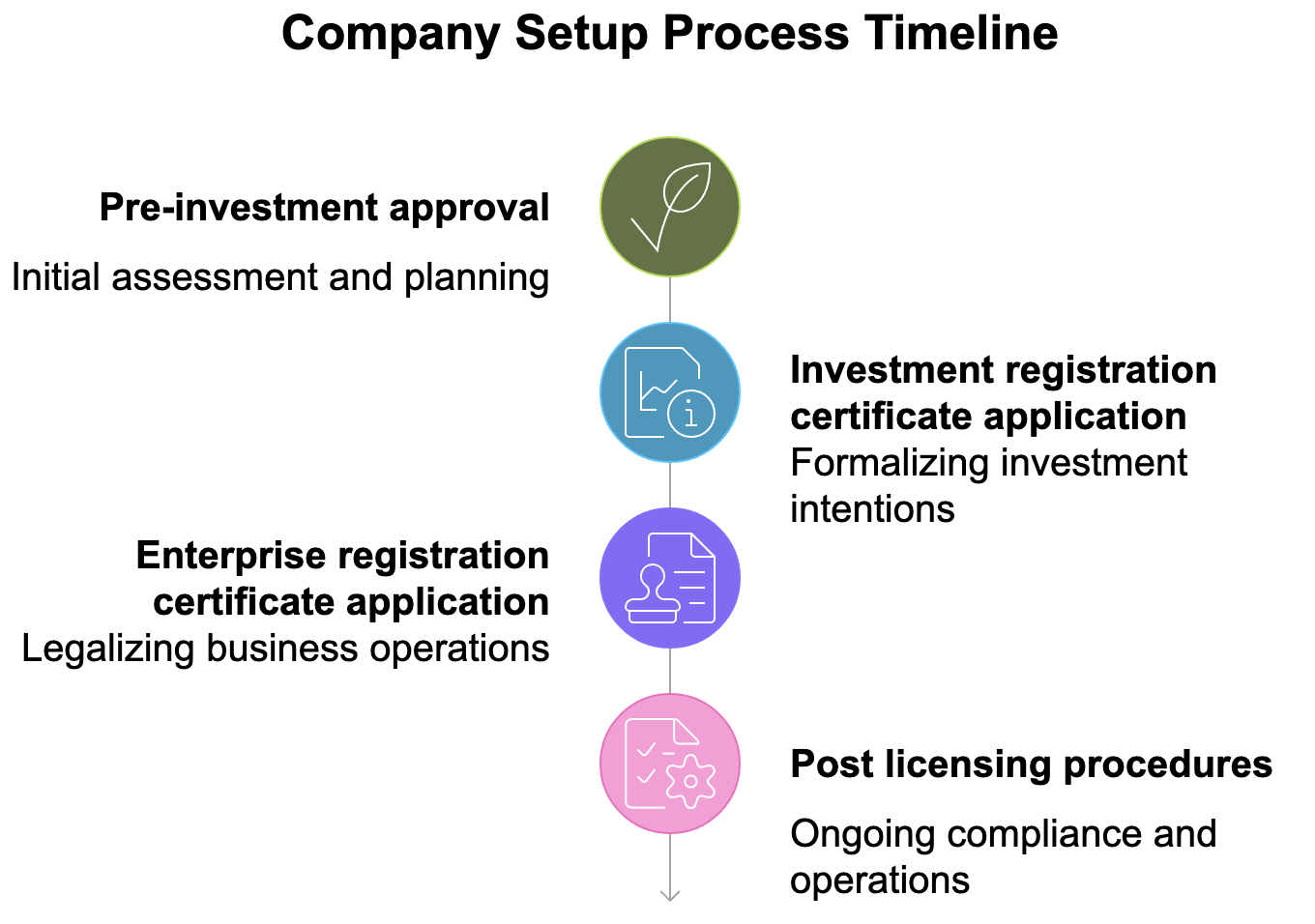
The formal process of establishing an FDI company in Vietnam involves a two-phase licensing procedure, followed by critical post-establishment steps. Understanding the requirements, timelines, and costs for each phase is essential for effective project planning.

The Investment Registration Certificate (IRC)

The IRC is the foundational license for any foreign investment project. It is an approval of the project itself, granted by the state, and precedes the formation of the legal entity.   

  • Application Dossier: A comprehensive dossier must be submitted, including:

    • The formal application form for the investment project.

    • Legal documents of the investor(s), such as the Certificate of Incorporation and company charter for a corporate investor, or a passport for an individual investor. All foreign-issued documents must be consular legalized in the investor's home country and then translated into Vietnamese by a certified translator. 

    • A detailed investment project proposal outlining objectives, scale, capital, and implementation schedule.

    • Documents proving the investor's financial capacity. This typically includes audited financial statements for the last two years for corporate investors or a bank statement confirming a balance equal to or greater than the proposed contribution for individual investors.  

    • An in-principle office lease agreement or a Memorandum of Understanding (MOU) for the proposed head office or project location.  

  • Licensing Authority: The application is submitted to the Department of Planning and Investment (DPI) of the province or city where the project will be located. If the project is situated within an industrial zone (IZ), export processing zone (EPZ), or high-tech zone (HTZ), the application is typically handled by the management board of that zone.  

  • Statutory Timeline: The legal processing time for an IRC application is 15 working days from the date a complete and valid dossier is received.  

The Enterprise Registration Certificate (ERC)

Once the IRC is issued, the investor can proceed to establish the Vietnamese legal entity by applying for an ERC.  

  • Application Dossier: The key documents for the ERC application include:

    • The formal application for enterprise registration.

    • The draft Charter (equivalent to Articles of Association) of the new company.

    • A list of members (for an LLC) or founding shareholders (for a Joint Stock Company).

    • A list of the company's Ultimate Beneficial Owners (UBOs), a new mandatory requirement from July 1, 2025. 

    • Notarized copies of the personal identification documents (e.g., passport) of the company's legal representative and all individual members/shareholders.

    • A copy of the newly issued IRC.

  • Licensing Authority: The application is filed with the Business Registration Office, a division of the provincial DPI. 

  • Statutory Timeline: The legal processing time for an ERC is significantly shorter, at just 3 working days from the submission of a valid application.  

Practical Guidance on Capital Requirements

Navigating Vietnam's capital requirements involves understanding the distinction between different capital types and the practical expectations of the licensing authorities.

  • Distinguishing Capital Types:

    • Investment Capital: This is the total fund registered in the IRC, encompassing both the investor's equity (charter capital) and any planned debt financing (loans) for the project.   

    • Charter Capital: This is the equity portion of the investment capital that investors commit to contribute. It is recorded in the ERC and must be fully paid within 90 days of the ERC's issuance. The amount of charter capital also determines the annual business license tax rate. 

    • Legal Capital: For certain conditional business lines (e.g., banking, insurance, securities, real estate), the law prescribes a minimum amount of charter capital that the company must have. This is known as legal capital.

  • Determining a "Reasonable" Capital Level: For the majority of business lines that do not have a specific legal capital requirement, the law does not set a minimum capital amount. However, this does not mean investors can register a nominal amount. The DPI will assess the "reasonableness" of the proposed charter capital in relation to the business plan, projected operational expenses, and the scale of the project. A capital amount deemed insufficient to sustain the business may lead to questions or delays in the approval process. 

  • Practical Advice: As a general guideline, investors should register a charter capital amount sufficient to cover projected operational expenses for at least the first 12 to 24 months. While it is technically possible to register a services company with as little as US$10,000 is often recommended. This amount is generally accepted by authorities as credible for a serious business venture and can also facilitate the subsequent application for long-term visas or temporary residence cards for the foreign investor. 

Estimated Timeline and Cost Analysis

The statutory timelines for licensing are often shorter than the practical reality. A realistic assessment of the time and cost involved is crucial for effective project management.

Practical Timeline for FDI Company Establishment

The following table provides a more realistic timeline that accounts for necessary preparatory work and potential administrative delays.

Step Activity Statutory Timeline Practical Timeline Key Considerations & Dependencies
1 Pre-Application Preparation N/A 2 - 4 weeks This phase includes document collection, consular legalisation, certified translation, office location search, and drafting the project proposal. The legalisation process can be a significant bottleneck.
2 IRC Application & Issuance 15 working days 4 - 6 weeks

This assumes a complete and valid dossier. The authorities may request additional information or clarification, which can reset the processing clock. 

3 ERC Application & Issuance 3 working days 1 - 2 weeks

This step is generally straightforward once the IRC has been successfully obtained.  

4 Post-Licensing Procedures N/A 2 - 4 weeks

This includes carving the company seal, opening bank accounts, initial tax and labour registrations, and VNeID registration for the legal representative.  

Total End-to-End Process ~4 weeks 2 - 4 months The total time is highly dependent on the complexity of the project, the investor's home country's legalisation procedures, and the thoroughness of the initial application.

Breakdown of Establishment Costs

It is essential to distinguish between the minimal government fees and the more substantial ancillary and professional service costs that constitute the true cost of establishment.

Cost Category Item Estimated Cost (USD) Notes
I. Government Fees ERC Application Fee ~$2 (VND 50,000)

This fee is often waived if the application is filed online.

  Publication Fee ~$4 (VND 100,000)

A mandatory fee for publishing the new company's registration details on the National Business Registration Portal.

  Business License Tax $85 - $130 / year

An annual tax paid by all businesses. The rate depends on the registered charter capital (VND 2-3 million).

II. Ancillary Costs Document Translation & Notarization $200 - $600+

The cost depends on the number and length of the investor's corporate documents that need to be translated and notarised.   

  Consular Legalization $100 - $400+

This is required for all foreign-issued corporate documents and must be done in the investor's home country. Fees vary by embassy/consulate.

  Office Rental (Initial Deposit) $500 - $1,500+

A registered physical address is mandatory. Virtual office services are a lower-cost option for some non-manufacturing sectors. 

III. Professional Service Fees Legal & Advisory Services $3,000 - $10,000+

Fees for a law or consulting firm to manage the entire IRC/ERC application process. The cost varies significantly based on the firm's reputation and the project's complexity. 

Total Estimated Initial Outlay   $4,000 - $12,000+ This estimate excludes the actual charter capital contribution.

Mandatory Post-Establishment and Operational Compliance

Receiving the ERC marks the legal birth of the company, but a series of critical post-licensing procedures must be completed immediately to make the company fully operational and ensure ongoing compliance.

Making the Company Seal and Opening Bank Accounts

Immediately after ERC issuance, the company must arrange for its official seal (company stamp) to be carved and must register the seal sample with the authorities. 

Following this, the company must open its bank accounts. This is a crucial step with specific requirements for FDI enterprises. The company must open at least two types of accounts:

  • Direct Investment Capital Account (DICA): This is a special-purpose foreign currency or VND account that is mandatory for all FDI enterprises. It is used exclusively to receive the charter capital contribution from the foreign investor. Subsequently, all capital-related transactions, such as receiving medium/long-term loans from abroad, and repatriating profits or the original investment capital, must be processed through the DICA. Failure to use a DICA for these transactions is a common and serious compliance violation that can lead to legal risks when transferring funds abroad.  

  • Current Account: A standard VND payment account is also required for conducting day-to-day domestic business transactions, such as paying suppliers, salaries, and taxes. 

The strict regulations governing the DICA underscore its function as a primary control mechanism for the State Bank of Vietnam to monitor foreign capital flows. It is more than a simple bank account; it is a regulatory gateway. Any procedural error, such as attempting to contribute capital through a regular payment account, can freeze a company's ability to be properly funded and prevent investors from legally receiving returns on their investment.

Capital Contribution: The 90-Day Deadline

Vietnamese law mandates that investors contribute their registered charter capital in full within 90 days from the date the ERC is issued. This contribution must be transferred from the overseas bank account of the investor directly into the newly opened DICA of the Vietnamese company. This deadline is strict and non-negotiable. Failure to contribute the capital on time can result in administrative sanctions, including significant fines and, in severe cases, the potential revocation of the company's IRC and ERC. 

Initial Tax Registrations and Payments

The ERC number also serves as the company's tax identification number. Upon establishment, the company must complete several initial tax-related procedures:

  • Digital Signature and E-invoicing: The company must purchase a digital signature token (also known as a USB token or digital certificate). This is required for electronically signing and submitting tax returns and other official documents online. The company must also register with the tax authorities to use electronic invoices (e-invoices) for all its sales transactions. 

    Business License Tax: The company must make its first annual payment of the Business License Tax. The deadline for this payment depends on the date of establishment.

Labour and Insurance Registration

To legally hire employees, the new company must register with the local labour authorities, typically by submitting a declaration of labour usage. Concurrently, the company must register with the social insurance agency. This registration is mandatory for making compulsory contributions for all Vietnamese employees under labour contracts, which include social insurance, health insurance, and unemployment insurance.

Ongoing Reporting Obligations

FDI enterprises are subject to a complex and rigorous system of periodic reporting to various government agencies. Failure to comply can result in fines and increased scrutiny. Key reporting requirements include : 

  • Investment Reports: The company must submit quarterly and annual reports to the DPI (or zone management board) detailing the implementation progress of its investment project. These reports cover aspects like capital disbursement, revenue, employee numbers, and technology usage.

  • Financial Reports: Annually, the company must have its financial statements audited by a licensed auditing firm in Vietnam. The audited report must then be submitted to the local tax authority, the DPI, and the statistics office within 90 days of the end of the financial year.

  • Labour Reports: Semi-annual and annual reports on labour utilisation, including details on employee numbers and changes in the workforce, must be submitted to the local labour department.

  • Sector-Specific Reports: Depending on the company's registered business lines, additional periodic reports may be required. For example, companies with a trading license must submit an annual report to the Department of Industry and Trade.

Critical New Compliance Imperatives for All FDI Enterprises

The post-July 2025 landscape is defined by two new, non-negotiable compliance mandates that fundamentally increase transparency and digitise corporate administration: Ultimate Beneficial Ownership disclosure and the VNeID e-identification system.

Ultimate Beneficial Ownership (UBO) Disclosure

Driven by FATF recommendations, the amended Law on Enterprises introduces a mandatory UBO reporting regime to combat money laundering and enhance corporate transparency.

  • Defining the Beneficial Owner: The law establishes a clear, two-pronged test to identify the UBO, who must be a natural person (an individual). 

    • Ownership Test: An individual is considered a UBO if they directly or indirectly own at least 25% of the company's charter capital or voting shares. The concept of indirect ownership requires companies to trace ownership through intermediary legal entities to the ultimate individual owner. 

    • Control Test: An individual is also considered a UBO if they exercise ultimate control over the company's key decisions, regardless of their ownership percentage. This includes the power to appoint or dismiss key management (e.g., directors, legal representative), amend the company charter, or decide on a restructuring or dissolution. 

  • Disclosure Procedures:

    • New Companies: From July 1, 2025, all new companies must include a list of their identified UBOs as a mandatory component of their initial ERC application dossier. 

    • Existing Companies: Companies established before this date are required to declare their UBO information the next time they file for any amendment to their business registration information (e.g., changing an address or legal representative).

    • Ongoing Obligation: The duty is continuous. Companies must notify the business registration authority of any changes to their UBOs within 10 working days of the change occurring. This information must be archived for at least five years after the company is dissolved. 

  • Strategic Implications: The UBO disclosure requirement represents a significant challenge to traditional investment structures that have relied on opacity. The explicit mandate to identify the ultimate individual controller, combined with the government's unrestricted access to this data for enforcement purposes, effectively undermines the viability of "disguised" ownership or nominee arrangements. Such structures have often been used to navigate foreign ownership limits in restricted sectors. Investors utilising complex offshore vehicles or informal nominee agreements now face a much higher risk of scrutiny and potential regulatory action.

The VNeID E-Identification Mandate

As part of its national digital transformation agenda, Vietnam now requires all legal entities to use a verified digital identity for official interactions.

  • The Requirement: Effective July 1, 2025, all companies must register for and use a corporate electronic identification (e-ID) account to conduct online administrative procedures. This includes essential functions like tax filing, customs declarations, and accessing the National Public Service Portal. Existing corporate accounts on these portals will become invalid after this date, making the new e-ID indispensable for operations.

  • The Registration Process: The process creates a direct link between the company and its leadership. A corporate e-ID can only be registered by the company's legal representative (or a duly authorised employee) using their own personal Level 2 VNeID account.

  • The Foreign Legal Representative Challenge: This process presents a significant and immediate challenge for FDI companies led by foreigners.

    • Eligibility and Procedure: Foreign nationals holding a valid Temporary Residence Card (TRC) are eligible to apply for a personal Level 2 VNeID. The application requires an in-person visit to the provincial immigration office to provide biometric data (fingerprints and a digital photograph) along with their original passport and TRC.

    • The Implementation Bottleneck: The system for registering foreigners was officially launched on July 1, 2025. Recognising the logistical challenge, the government has initiated a "campaign" period running until August 19, 2025, to accelerate registrations, to have the system fully operational by that date. The critical issue is that until a foreign legal representative successfully obtains their personal Level 2 VNeID, the company they lead

      ...cannot register its mandatory corporate e-ID.

    • Interim Solution: Tax authorities have unofficially indicated that companies may temporarily continue using their existing online tax filing accounts until the VNeID issuance process for foreigners is stabilised. However, this is a temporary workaround for a single administrative function and does not resolve the broader legal requirement.

The VNeID mandate creates a critical path dependency that could stall a new FDI company's ability to operate. The required sequence is rigid and linear: the foreign legal representative must first secure a TRC, then use it to register for a personal Level 2 VNeID, and only then can the company register its corporate e-ID. A delay at any point in this chain has a cascading effect, potentially causing the company to miss statutory deadlines for tax filing and other obligations, leading to penalties. Any new FDI company established in mid-2025 with a foreign legal representative is therefore in a race against time, its operational compliance entirely dependent on the successful and timely rollout of a brand-new government IT system for foreigners.

These two new requirements—UBO disclosure and VNeID—should be viewed as twin pillars of a new, more robust enforcement regime. They are not merely about digitisation or transparency for its own sake. The UBO data provides authorities with a clear map of ultimate control, while the VNeID system creates a verified, unforgeable digital link between the actions of the company and the individual legally responsible for them. This allows government agencies to cross-reference ownership data with authenticated transactions, creating a highly auditable trail of corporate activity. It significantly lowers the barrier for assigning personal liability and enforcing regulations related to tax compliance, capital contributions, and adherence to market access conditions, fundamentally raising the stakes for corporate governance in Vietnam.

Strategic Recommendations and Outlook

Navigating Vietnam's modernised but more complex investment landscape requires proactive planning and a deep understanding of the new compliance imperatives. The following recommendations are designed to help prospective investors mitigate risks and capitalise on the opportunities presented by the post-July 2025 framework.

Compliance Checklist for New Investors Post-July 2025

A systematic approach is essential. Investors should follow a clear checklist:

  1. Pre-Investment Due Diligence:

    • Conduct rigorous internal due diligence to identify every Ultimate Beneficial Owner (UBO) according to both the 25% ownership and the control tests.

    • Thoroughly vet the chosen business sector against Vietnam's list of conditional business lines and relevant FTA commitments (CPTPP/EVFTA) to confirm market access and foreign ownership limits.

  2. Document Preparation:

    • Initiate the consular legalisation process for all required foreign corporate documents as early as possible, as this is often the most time-consuming step.

    • Ensure the financial capacity proof is robust and clearly demonstrates the ability to fund the proposed charter capital.

  3. Licensing Phase:

    • Submit a complete and meticulously prepared IRC application to minimise requests for clarification from the authorities.

    • Upon receiving the IRC, immediately prepare and file the ERC application, including the mandatory new list of UBOs.

  4. Immediate Post-Licensing Actions (First 90 Days):

    • Carve the company seal and open the Direct Investment Capital Account (DICA) and a local currency current account.

    • Ensure the foreign legal representative applies for their Temporary Residence Card (TRC) immediately upon arrival.

    • As soon as the TRC is issued, the legal representative must complete the in-person registration for their personal Level 2 VNeID account.

    • Use the newly acquired personal Level 2 VNeID to register the company's mandatory corporate e-ID account.

    • Transfer the full charter capital into the DICA well before the 90-day deadline.

    • Complete initial tax, labour, and insurance registrations.

Mitigating Risks in the New Regulatory Framework

  • VNeID Risk Mitigation: The most acute short-term risk is operational paralysis due to delays in VNeID registration for a foreign legal representative. To mitigate this, companies should consider appointing a trusted Vietnamese national as a second legal representative during the initial establishment phase. This allows the company to register its corporate e-ID immediately using the Vietnamese representative's existing VNeID, ensuring that critical functions like tax filing can proceed without delay while the foreign representative completes their registration process.

  • UBO Compliance Risk: For investors with complex, multi-layered ownership structures (e.g., private equity funds, trusts), it is crucial to seek a formal legal opinion to accurately identify all individuals who meet the UBO criteria under Vietnamese law. Given the government's clear intent, the use of nominee shareholding structures, particularly in sectors with foreign ownership restrictions, should be avoided as they now carry a significant risk of being deemed non-compliant.

  • Capital Contribution Risk: The 90-day capital contribution deadline should be treated as absolute. Investors must account for potential delays in international bank transfers and ensure funds are dispatched with ample time to meet the deadline.

Maximising Opportunities from New High-Tech Incentives

For investors operating in prioritised sectors like semiconductors, AI, data centres, or other innovative technologies, the new laws offer unprecedented opportunities.

  • To qualify for special incentives, investment proposals should be explicitly structured to meet the qualifying criteria, such as the VND 6,000 billion capital threshold and the five-year disbursement plan.

  • Investors in these fields should actively leverage the new "fast-track" provision that allows for the establishment of the legal entity before the IRC is granted. This can significantly accelerate project timelines, allowing for earlier hiring, contracting, and operational setup.

Concluding Analysis: Vietnam's Trajectory as a Premier FDI Destination

The legislative changes of 2025 mark a clear maturation in Vietnam's approach to foreign investment. The new landscape can be characterised by a policy of "strategic friction." The government is intentionally increasing the compliance and transparency requirements to create friction for low-value, non-transparent, or technologically lagging investments. Simultaneously, it is removing friction and rolling out the red carpet for the high-quality, strategic FDI it seeks to attract.

Vietnam remains a premier destination for foreign investment, but the rules of engagement have changed. The successful investor in this new era will no longer be the one who simply brings capital, but the one who brings a commitment to high standards of corporate governance, technological advancement, and regulatory compliance. Success will be defined by the ability to prioritise robust legal frameworks from day one, to understand and align with the government's strategic economic goals, and to possess the sophistication required to operate effectively in a more digitised, transparent, and demanding administrative environment.

LHD Law Firm is rated in the top 10 leading law firms in Vietnam in terms of consulting on setting up foreign capital companies in Vietnam, ranked at Legal500 and Hg.org.

⭕ Set up a company in Vietnam, Services advised by LHD Law Firm

  • Advising on conditions for establishing foreign-invested companies for investors according to specific business fields or investors' nationality;
  • Consulting on selecting the correct type of company for investors: Limited liability company or Joint-stock company, head office address, capital, business lines, opening a capital transfer account, capital contribution term, etc
  • Guide investors to prepare the necessary documents to establish a foreign-invested company;
  • Consulting and drafting company establishment documents for investors;
  • Representing investors to work with competent Vietnamese state agencies in the process of establishing businesses for investors
  • Apply for a foreign loan for a business to borrow from a parent company or a foreign organisation.
  • Exhaustive advice on activities arising in the process of doing business in Vietnam for investors.

(License company in Vietnam has to obtain an Investment Registration Certificate (“IRC”) first for its “investment project”, then continue by obtaining an Enterprise Registration Certificate (“ERC”)

Set up company in vietnam - lhd advice

LHD Law Firm is the top law firm consulting for expats in Vietnam

According to the rankings of Legal500 and Hg.org, LHD Law Firm is one of the 10 leading legal services in Vietnam for our consultancy on establishing a foreign-owned capital business in our country. With 15 years of experience in the field and the office system throughout the country: Ho Chi Minh City, Hanoi, Da Nang, Vung Tau, etc., LHD Law Firm takes pride in our commitment to satisfying our clients as foreign investors in Vietnam.

With 15 years of experience in consulting foreign companies, LHD Law Firm has advised more than 6889 successful investment projects in Vietnam with a capital of more than 5 billion USD and clients from 32 countries... Below are our regular customers:

[TOYOTA; WACOAL, DELOITTE; DLH; SHISEIDO; FOS; DLT; YAMAZEN; SANKOUGIKEN; DIEMSANG; IFO; Altech; TRIUMPH; SOMETHINGHOLDINGS, SPGROUP, FINEXHR, BGRIMM, SUPER ENERGY, ACTIS...]

⭕ Type business in Vietnam

Generally, the choice of the type of foreign-invested company establishment in Vietnam will have 3 main types.

1. Limited Liability Company (LLC) with one participant (For 1 individual investor or 1 investment organisation)

2. LLC with 2-50 participants (for 2 or more individuals, or 2 or more organisations, or 1 individual + 1 organisation)

3. A joint-stock company with 3 or more shareholders (for 3 or more natural persons or 3 or more organisations, or 1 natural person + 2 organisations...)

☑ Set up A limited liability company with 100% foreign investors is established

  • THE ONE MEMBER LIMITED LIABILITY COMPANY
  • MULTI-MEMBER LIMITED LIABILITY COMPANY

☑ Set up a Multi-member Limited Liability Company with foreign capital

1. Multi-member limited liability company is a company with from 02 to 50 participants who are organisations or individuals. A participant shall be liable for debts and other property obligations of the company to the extent of the amount of capital contributed to the company, except for the case specified in Article 47(4) of this Law. The contribution of a participant may be transferred only by the provisions of Articles 51, 52 and 53 of this Law.

2. Multi-member limited liability company shall have legal status from the date of issue of the certificate of incorporation of the company. 

3. A Limited Liability Company with two or more partners shall not be entitled to issue shares, except in the case of transformation into a joint stock company.

4. A limited liability company with two or more participants may issue bonds by this Law and other relevant laws; private placement of bonds shall comply with the provisions of Articles 128 and 129 of this Law.

☑ Set up a joint stock company with 100% foreign capital

Article 111. Joint stock companies

(1)  A joint stock company is a business that:

a) The share capital is divided into equal parts called shares.

b) The shareholders may be organisations or individuals; the minimum number of shareholders is 03, the maximum number is unlimited.

c) Shareholders are liable for debts and other property obligations of the company only within the limits of the amount of capital, contributed to the company.

d) The shareholders have the right to freely transfer the shares they own to other persons, except in the cases stipulated by clause 3 of Article 120 and clause 1 of Article 127 of this Law.

(2) A joint stock company has the legal status from the date of issuance of the business registration certificate.

(3) Joint-stock companies shall have the right to issue shares, bonds and other types of securities of the company.

When establishing a foreign corporation in Vietnam, what permits are required?

- Apply for provincial people's committee policy (except central cities)

- Investment Certificate (IRC)

- Business Registration Certificate (ERC)

- Business License → (If you have a retail business)

☖ ORDERING CONSULTING FOR THE CREATION OF A FOREIGN CAPITAL COMPANY

► Review the documents to be prepared, including LEGAL CONSULTATIONS (LAW, POLICY, TAXES, human resources...)

► After receiving the investment certificate, provide advice on how to obtain the business registration certificate.

► Advice and application for the Enterprise Certificate (ERC) and the Investment Certificate (IRC), in addition to the Business License issued by the Ministry of Industry and Trade (Business License)

► Consultation and production of a seal engraving and report using seal samples

► Regular legal advice after the opening of the business

► Legal advice about taxes, work permit, temporary residence card and child permit (if applicable)

► Support for the registration of trademarks, designs and inventions when required by businesses (LHD Law Firm is a representative of IP No. 146, the National Office of Intellectual Property, NOIP)

Process step by step set up company - LHD Law Firm

☖ SERVICES TO BE AVAILED OF AFTER SETTING UP A FOREIGN CAPITAL COMPANY IN VIETNAM

►Advice on CIT, PIT, and monthly, quarterly and annual tax returns

►Social insurance consultation, salary calculation (payroll)

►Consulting for personnel selection in Vietnam

►Trademark, Design, and Invention Protection Consulting

►Consultation on labour law, taxation, and contracts in Vietnam

► Virtual office rental for companies with foreign capital to provide invoice redemption.

CONTACT US FOR SERVICES  --> Currently, LHD Law Firm has 3 offices in 3 major cities in Vietnam: Ho Chi Minh City, Hanoi and Da Nang.→ Over 6,800 clients from 32 countries around the world have trusted the services of LHD Law Firm for 15 years.

☑ Work with Us 

Step 1: Get Legal Advice in English - Vietnamese

Meet with an attorney. We get legal advice on the type of business best suited to your situation.

Step 2: Find office space and legal representation for your business (if there is no available LHD Law Firm)

Then find an office space so that your business not only has a place of business but also a specific office address required by the government to apply for a business license. If you are not the legal representative for your business, you need to find a trusted partner.

Step 3: Apply for a business license (IRC, ERC or BL)

Prepare all the necessary documents and make sure that you meet all the requirements before applying for a business license. Expect a 15-day waiting period for a Vietnamese-owned company and a 60-day waiting period for a foreign company.

Step 4: Legal and tax advice for foreign companies after establishment

Running your Vietnamese business now can hire employees and enter into business contracts. There are several things you need to do, such as obtaining your company seal, applying for a tax identification number, opening a company bank account, and publicly announcing your incorporation. Periodic duties include employee tax, accounting report and insurance payments.

(In addition to legal advice, we also provide accounting services for companies with foreign capital for these companies)

☑ Why Choose LHD Law Firm

Everything we do at LHD Law Firm is focused on assisting your business through our investment law expertise and local business experience in Vietnam.

So that your enterprise can grow and expand quickly and avoid the costly traps that many start-up investors fall into at the hands of unscrupulous lawyers and agents. How do we accomplish this?

We offer the best investment legal service in Vietnam, as well as a wide choice of INDIVIDUAL AND ECONOMIC EFFECTIVE SOLUTIONS for starting a business in Vietnam or managing an existing one.

What we can do ...

Consulting on the establishment of foreign-owned companies in Vietnam, consulting on the establishment of Vietnamese factories and consulting on industrial production, sourcing Vietnam, supporting business registration, accounting, and tax compliance through information intelligence, low-cost operational setup, HR & admin, government liaison services, director services, country representation/management services for M&A, and much more...
 

→ Senior lawyer LAW FIRM

Lawyer: Thanh Thuy (email: all@lhdfirm.com) 

  • Lawyer specialising in advising on setting up foreign capital companies in Ho Chi Minh City
  • She graduated with a master’s degree in Commercial Law - City Law University of Ho Chi Minh City.
  • Consultancy language: English and Vietnamese

She is one of the top 20 lawyers in Vietnam, highly rated by Legal500 and Hg.org → specialises in foreign investment, having realised more than 6800 projects in 15 years...

Lawyer: Phuong Khanh (email: hanoi@lhdfirm.com)

A lawyer specialising in advising on setting up foreign capital companies in Hanoi

She has a master's degree in Commercial Law from Hanoi Law University.

The language of consultation is English and Vietnamese

A senior associate at an LHD Law Firm in Hanoi, she has 15 years of experience in foreign investment consulting, having implemented more than 2,466 projects in Vietnam.
 
YOU ONLY NEED TO PREPARE YOUR FINANCIAL AND BUSINESS STRATEGY; WE WILL SUPPORT YOU WITH A COMPLETE PLAN AND LEGAL WORK IN VIETNAM
 

To seek further advice or request service to set up a company in Vietnam, contact us by: ☑: all@lhdfirm.com

☎: Call, iMessage,  SMS, WhatsApp, Viber: +84931767568 
Written and reviewed by Ms. Nguyen Ngan Phuc

Comment

OUR PARTNERS

SP Group logo
Bgrimmpower
Levanta Renewables
Supercorp
TAF Toyota
Maersk
Yamazen
Beiersdorf.vn
Saigon Co.op
Thyssenkrupp
PKDVN
Ricoh
Fivimart
Wacoal Viet Nam
Sumitomodrive