Vietnam is one of the fastest-growing economies in the world. The low cost of living and highly qualified population make it an ideal location for foreign companies who are looking to branch out and invest. However, expanding internationally has its disadvantages as well. Not knowing the local laws and regulations makes it a thousand times harder to open a company overseas.
Vietnam has firmly established itself as a premier destination for foreign direct investment (FDI) in Southeast Asia, propelled by a combination of sustained economic growth, a dynamic demographic profile, and a government that actively encourages strategic foreign capital. For international investors, understanding the nuances of this landscape is the first step toward a successful market entry.
Even amidst global economic uncertainty, the Vietnamese economy has demonstrated remarkable resilience, maintaining a high growth rate that continues to attract international attention.1 This economic vitality is not a fleeting trend but is underpinned by strong fundamentals, chief among them being the country's large and youthful population. With over 100 million people, more than half of whom are under the age of 35, Vietnam offers a dual advantage: a vast, trainable workforce and a burgeoning consumer market with growing disposable income
Foreign direct investment is a cornerstone of this economic success. At the close of 2024, Vietnam's accumulated FDI stock exceeded $322 billion, a figure roughly equivalent to two-thirds of the nation's GDP, underscoring the integral role foreign capital plays in its development. The Vietnamese government recognises this symbiotic relationship and actively cultivates it. Senior government leaders frequently engage with foreign investors and private sector representatives to reinforce Vietnam's appeal as an FDI hub. Furthermore, institutionalised platforms such as the semi-annual Vietnam Business Forum provide a direct channel for investors to communicate with government officials, a mechanism that has proven effective in addressing and resolving operational obstacles.2
Vietnam's approach to attracting FDI is increasingly sophisticated and targeted. The government is not merely seeking capital but is actively steering investment toward sectors that align with its long-term strategic development goals. Particular emphasis is placed on attracting high-value FDI in future-focused industries, including high-tech manufacturing, renewable energy, semiconductors, and artificial intelligence (AI). This strategic focus is articulated in national investment strategies that aim to increase the presence of Fortune 500 companies and improve Vietnam's standing in global business climate indices.
To encourage investment in these priority areas, the government offers a range of compelling incentives. Foreign investors in designated sectors may benefit from exemptions on import duties for goods imported for their own use that cannot be procured locally, such as specialised machinery or raw materials. Favourable land rental rates are also a common incentive. The sectors officially designated as eligible for these benefits include, but are not limited to, advanced technology, research and development (R&D), new materials, software development, waste treatment and management, and certain areas of education. This framework signals to investors that proposals aligned with Vietnam's technological and sustainable development ambitions are more likely to receive favourable treatment and a smoother path to approval.
A significant draw for foreign investors is Vietnam's generally open policy on foreign ownership. In compliance with its World Trade Organisation (WTO) commitments, Vietnam permits 100% foreign ownership in the majority of business sectors. This allows investors to establish wholly foreign-owned enterprises, granting them complete operational control without the need for a local partner.
However, this open-door policy is not universal. The government maintains restrictions on foreign ownership in several key and sensitive sectors. For industries such as advertising, tourism, and oil and gas, a joint venture with a Vietnamese partner is typically mandatory. Other sectors with statutory restrictions on foreign control or requirements for joint partnerships include banking, non-infrastructure telecommunications services, transportation, and defence. The government reserves the right to halt any foreign investment project it deems potentially harmful to national security. These Foreign Ownership Limits (FOLs) are not static; they are periodically reviewed by the government, with the Ministry of Finance (MOF) playing a central role in assessing and adjusting the regulations based on evolving economic goals and national interests
The choice of location is a critical early decision with long-term operational and logistical implications. Vietnam's two primary economic and political centres are Ho Chi Minh City (HCMC) and Hanoi. HCMC, in the south, is the nation's undisputed commercial and financial hub, offering a dynamic business environment and extensive logistics infrastructure. Hanoi, the capital city in the north, is the political and administrative centre, providing proximity to key government ministries and regulatory bodies.
A non-negotiable legal requirement for any business incorporation is securing a legal, physical address in Vietnam. This address is necessary for the registration process and for obtaining subsequent licenses. Investors should factor real estate costs into their initial budgets. In major urban centres like HCMC and Hanoi, commercial rental rates can be expected to range from approximately $20 to $40 USD per square meter per month, varying by location and building quality. For businesses that do not immediately require a physical office, utilising a registered or virtual office service can be a compliant and cost-effective interim solution.
Selecting the appropriate legal entity is one of the most consequential decisions an investor will make when entering Vietnam. The choice of corporate structure dictates critical aspects of the business, including liability, capital mobilisation capabilities, management governance, and long-term strategic flexibility. The Vietnamese Law on Enterprises provides several options, with the Limited Liability Company (LLC) and the Joint Stock Company (JSC) being the most common for foreign investors.
The Limited Liability Company is the most popular corporate structure for foreign investors in Vietnam, particularly for small- to medium-sized enterprises (SMEs).1 Its popularity stems from its straightforward structure, strong liability protection, and operational flexibility.
The defining feature of an LLC is that the liability of its members is limited to the extent of their capital contribution to the company.7 This legal firewall protects the personal assets of the owners from the company's debts and obligations. An LLC can be established with as few as one owner, known as a single-member LLC, making it an ideal vehicle for a wholly-owned subsidiary of a foreign parent company.1 The structure can accommodate up to 50 members in total.1 A significant characteristic that distinguishes an LLC from a JSC is its inability to issue shares to the public, which means it cannot be listed on a stock exchange to raise capital.10 This makes the LLC structure better suited for businesses that are privately funded or do not envision public capital raising as part of their growth strategy.
The Joint Stock Company is the preferred legal entity for large-scale ventures and for businesses that plan to raise significant capital from external sources.1 A JSC is required to have a minimum of three shareholders at its inception, with no maximum limit on the number of shareholders it can have thereafter.1
The primary advantage of the JSC structure lies in its capital-raising capabilities. Unlike an LLC, a JSC's charter capital is divided into shares, which can be freely issued and transferred, subject to certain limited restrictions on founding shareholders in the first three years.7 This feature allows a JSC to raise capital by issuing shares to new investors or by listing on a public stock exchange.10 This makes the JSC the only viable option for companies planning an Initial Public Offering (IPO) in Vietnam. Furthermore, for foreign investors looking to acquire a stake in a state-owned enterprise that has been "equitized" (privatised), the JSC is the mandatory legal structure.14 The decision to form a JSC is a strategic one, signalling an ambition for significant growth and access to public capital markets, which in turn necessitates a more complex and transparent governance structure compared to an LLC.
Beyond the LLC and JSC, Vietnam offers several other entry modes for foreign entities, each designed for specific, limited purposes.
Representative Office (RO): An RO is not a separate legal entity but rather an extension of its foreign parent company. Its activities are strictly limited to non-profit-generating functions such as market research, acting as a liaison office, and promoting the parent company's business. An RO cannot sign commercial contracts, issue invoices, or receive payments directly. It is an ideal, low-commitment structure for companies wishing to explore the Vietnamese market and build a presence before making a full-scale investment.
Branch Office (BO): A branch office is also a dependent unit of its foreign parent company, but, unlike an RO, is permitted to conduct commercial, profit-generating activities. It can acquire necessary permits and conduct business directly. However, the foreign parent company remains fully liable for all debts and obligations of its Vietnamese branch.
Joint Venture (JV): A joint venture is a partnership formed between a foreign investor and a Vietnamese company. While a JV can be entered into voluntarily to leverage a local partner's market knowledge, distribution network, or resources, it is often a mandatory requirement for market entry in sectors with foreign ownership restrictions.5 The profit-sharing and management structure are defined by the joint venture agreement between the parties.
| Feature | Limited Liability Company (LLC) | Joint Stock Company (JSC) | Representative Office (RO) |
| Suitable For |
SMEs, wholly-owned subsidiaries, controlled investments |
Large-scale ventures, companies planning public listing or significant fundraising |
Market research, liaison activities, brand promotion, and pre-investment presence |
| Number of Owners |
1 to 50 members |
Minimum of 3 shareholders, no maximum limit |
Not applicable; owned by the foreign parent company |
| Liability |
Limited to the amount of capital contributed |
Limited to the value of shares owned |
The foreign parent company bears unlimited liability |
| Capital Mobilization |
Cannot issue shares or be publicly listed |
Can issue shares and bonds; can be listed on a stock exchange to raise public capital |
Cannot engage in activities that generate profit or raise capital |
| Transfer of Ownership |
Restricted. A member must first offer their capital portion to other existing members before transferring to an external party. |
Shares are generally freely transferable, facilitating liquidity and exit strategies. |
Not applicable; ownership cannot be transferred. |
| Management Structure |
Members' Council, Chairman of the Members' Council, Director/General Director. |
General Meeting of Shareholders, Board of Management, Director/General Director, Supervisory Board (if applicable). |
Head of the Representative Office, appointed by the parent company. |
| Profit-Generating Activities |
Yes |
Yes |
No. Strictly prohibited from conducting direct commercial activities. |
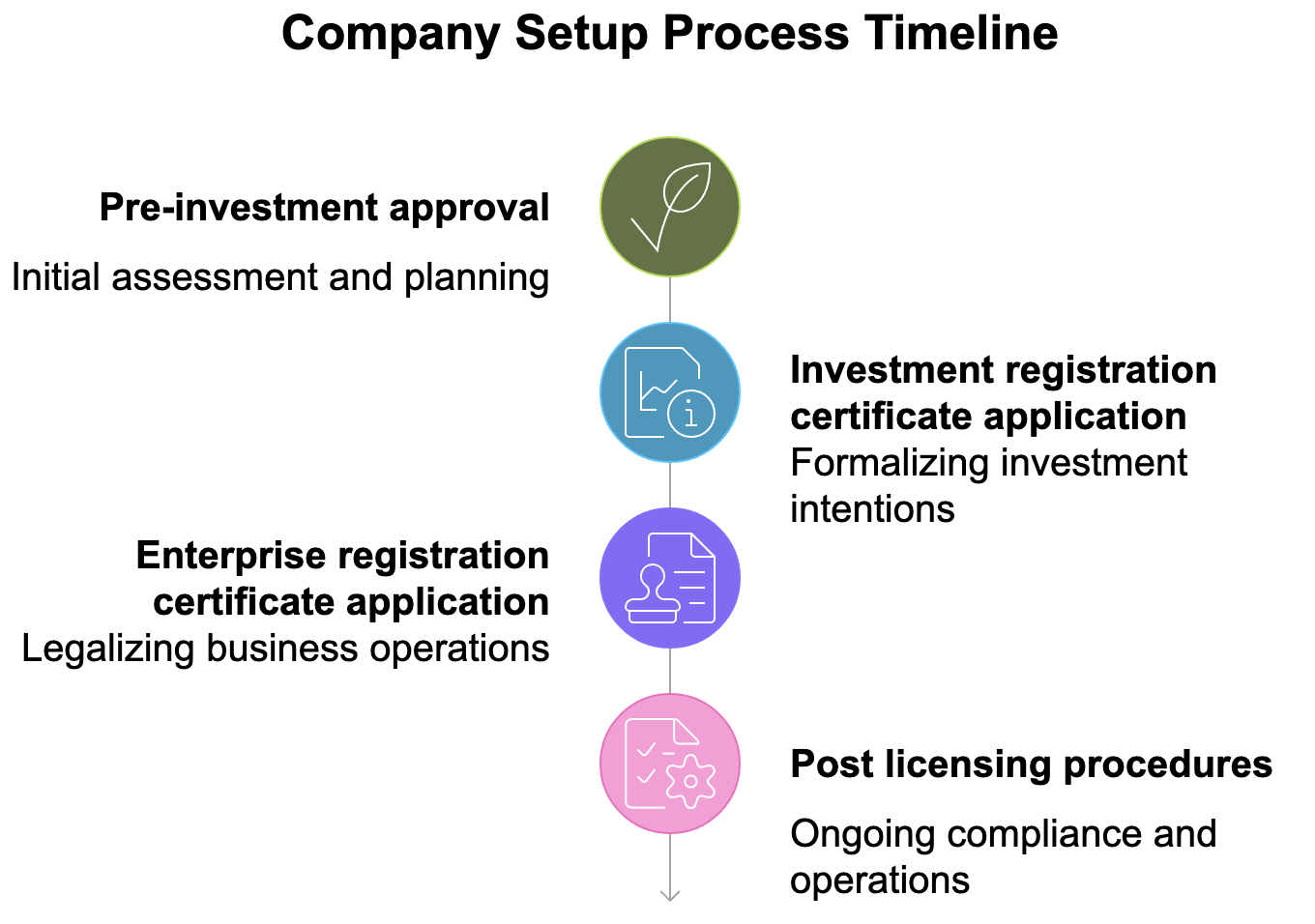
The legal process of establishing a foreign-invested company in Vietnam is a structured, multi-stage procedure governed primarily by the Law on Investment and the Law on Enterprises. It is a path that requires meticulous preparation of documents, a clear understanding of capital requirements, and sequential approvals from government authorities. For foreign investors, the process is fundamentally a two-step licensing journey: first, securing an Investment Registration Certificate (IRC) to approve the investment project, and second, obtaining an Enterprise Registration Certificate (ERC) to legally form the company.
Capitalisation is a foundational element of the incorporation process in Vietnam. While the regulations offer flexibility in most sectors, the amount of capital an investor commits is subject to scrutiny and carries significant legal and practical implications.
Charter Capital is the total value of assets that the members or shareholders of a company commit to contribute upon its establishment.This is a legally binding commitment. Under Vietnamese law, investors must contribute their committed charter capital in full within 90 days from the date the Enterprise Registration Certificate (ERC) is issued. This is a strict deadline, and failure to comply can lead to penalties. All capital contributions from foreign investors must be transferred into Vietnam through a specially designated bank account known as a Direct Investment Capital Account (DICA)
For the majority of business lines, Vietnamese law does not prescribe a specific minimum capital requirement. This flexibility is intended to encourage investment across a wide range of industries. However, this does not mean that capitalisation is unregulated. The provincial Department of Planning and Investment (DPI), the authority responsible for issuing the initial investment license, is tasked with assessing whether the proposed charter capital is "adequate" to fund the business's operations until it can become self-sufficient and cover its own expenses.
This "adequacy" test introduces a subjective element into the process. The amount of declared capital is therefore not just a financial entry but a signal of the project's viability and the investor's commitment. A declaration that is perceived as too low may trigger questions from the DPI or even lead to the rejection of the investment application. Based on practical experience, while a service-based business might be established with as little as USD 10,000 in some cases, a safer and more commonly accepted range for broader business activities is between USD 25,000 and USD 40,000.1 This level of capital is generally viewed by authorities as a credible commitment for a serious business venture.
While most sectors have no fixed minimum, certain "conditional" business lines are subject to legally mandated minimum capital levels, known as legal capital.16 These requirements are in place for industries that are considered to have a higher impact on the economy, public safety, or national security. Investors planning to operate in these sectors must ensure their committed capital meets these statutory thresholds.
Specific examples include:
Education: The requirements are highly specific and calculated on a per-student basis. For preschools, the minimum is VND 30 million per child. For K-12 schools, it is VND 50 million per student, with a minimum total investment of at least VND 50 billion. Higher education institutions require a minimum total investment of VND 1,000 billion.
Real Estate: The formal requirement of VND 20 billion in legal capital has been amended under the 2020 Law on Investment. However, to implement a real estate project, investors must still demonstrate they possess equity capital equivalent to at least 15% to 20% of the total project investment, depending on the project's land size.
Finance and Banking: This sector is explicitly noted as having mandatory minimum charter capital requirements to ensure financial stability.
Security Services: A foreign investor contributing capital to a Vietnamese security services enterprise must ensure the company meets a minimum capital of VND 1 billion.23
A critical piece of financial infrastructure for any foreign-invested enterprise (FIE) in Vietnam is the Direct Investment Capital Account (DICA). It is mandatory for all foreign investors to open a DICA at a legally licensed bank in Vietnam. This special-purpose bank account serves as the official channel for all capital-related transactions between the foreign investor and their Vietnamese entity.
Its primary functions are twofold:
Inflow: To receive the initial charter capital contributions from the foreign investor.
Outflow: To remit profits, dividends, and other legally permissible earnings back to the foreign investor's home country.24
The DICA system allows the State Bank of Vietnam to monitor foreign currency flows, ensuring transparency and compliance with investment and foreign exchange regulations.
The Investment Registration Certificate is the first and most significant hurdle in the incorporation process for a foreign investor. It represents the government's approval of the investment project itself and is a prerequisite for forming the legal entity.
The IRC is a mandatory license for all investment projects established by foreign investors in Vietnam. Its purpose is to officially establish the legal right of the foreign individual or organisation to invest in the country. The application is a substantive review of the investment's feasibility, financial backing, and alignment with local regulations. The primary authority responsible for reviewing applications and issuing the IRC is the Department of Planning and Investment (DPI) at the provincial or city level where the project will be located.1
A successful IRC application hinges on the submission of a complete and meticulously prepared dossier. Any errors or omissions can lead to significant delays. The core documents required include:
Application Form for Implementation of Investment Project: The official request form as prescribed by law.
Investment Project Proposal: This is the centrepiece of the application. It is a comprehensive document that must detail the project's objectives, scale, total investment capital and capital mobilisation plan, location, operational duration, project implementation schedule, labour requirements, requests for any investment incentives, and an assessment of the project's socio-economic impact.25
Proof of Investor's Legal Status:
For Individual Investors: A notarised and certified copy of a valid passport or other official identification document.
For Organisational Investors: A notarised copy of the Certificate of Incorporation or an equivalent document proving the legal establishment of the parent company. This document must undergo consular legalisation in the investor's home country before being submitted in Vietnam.
Proof of Financial Capacity: The investor must provide robust evidence of their ability to finance the project. This is a critical point of scrutiny for the DPI. Acceptable documents include one of the following:
The parent company's audited financial statements for the last two years.
A formal letter of commitment of financial support from the parent company or a reputable financial institution.
A bank statement or official bank letter confirming that the investor holds a cash balance greater than the proposed charter capital contribution.
Lease Agreement or Memorandum of Understanding (MOU): Documents providing evidence of the right to use the proposed location for the company's head office or project site. This can be a formal lease agreement or an MOU with the landlord.
A crucial procedural note is that all documents originating from a foreign country must be notarised, then legalised by the relevant consular authority of Vietnam in the investor's home country, and finally translated into Vietnamese by a certified translator.
The application process begins with the submission of the complete dossier to the relevant provincial DPI. In recent years, an initial online registration on the National Foreign Investment Information System is often the first step, followed by the submission of hard-copy documents.
The official processing timeline for an IRC application is typically 15 working days from the date of receipt of a valid and complete application. However, this timeline can be extended, sometimes up to 45 days or more, for several reasons. Delays are common if the project falls into a "conditional" business sector, requires special approvals from other ministries, or operates in an industry not explicitly covered by Vietnam's WTO commitments.7 The substantive nature of the IRC review means that the DPI's assessment of the project's viability is the most challenging part of the entire incorporation process.
Once the IRC has been successfully obtained, the second and final step in the licensing process is to secure the Enterprise Registration Certificate. This stage is significantly more procedural and faster than the IRC application, as the substantive approval for the investment has already been granted.
The ERC, also commonly referred to as the Business Registration Certificate (BRC), is the legal document that officially gives birth to the new company as a distinct legal entity in Vietnam.1 Upon issuance of the ERC, the company legally exists and can begin the post-incorporation steps to become fully operational.
A critical feature of the ERC is that it contains the company's unique enterprise registration number. This number also serves as the company's official Tax Identification Number (TIN), automatically registering the new entity with the local tax authorities.
The dossier for the ERC application focuses on the corporate formalities of the new company. The required documents include:
Application Form for Enterprise Registration: The standard form for business registration.
Company Charter (Articles of Association): This is the company's constitution, outlining its governance, management structure, and internal regulations.
List of Members or Shareholders: A list detailing the owners of the company (members for an LLC, shareholders for a JSC) and their respective capital contributions or shareholdings.
List of Legal Representatives: Identification and details of the individual(s) appointed as the legal representative(s) of the company.
Personal Identification Documents: Notarised copies of the valid passports or ID cards of all individual members/shareholders and of the appointed legal representative(s).
Copy of the Investment Registration Certificate (IRC): A valid, issued IRC is a mandatory attachment. The ERC application cannot be submitted, let alone processed, without it.
It is a fundamental rule of the process that the IRC and ERC applications cannot be processed concurrently. The IRC must be secured first. The complete ERC dossier is submitted to the Business Registration Office, which is a division of the same provincial DPI that issued the IRC.
The processing time for the ERC is remarkably swift compared to the IRC. The statutory timeline is just 3 to 5 working days from the submission of a valid and complete application.7 This reflects the procedural nature of the ERC issuance, which primarily verifies that the corporate documents are in order, rather than re-evaluating the investment project itself.
| Stage | Certificate Name | Purpose | Key Documents | Issuing Authority | Standard Timeline |
| Stage 1 | Investment Registration Certificate (IRC) | To obtain government approval for the foreign investment project itself. |
Application Form, Investment Project Proposal, Proof of Investor's Legal Status, Proof of Financial Capacity, Office Lease Agreement/MOU.25 |
Department of Planning and Investment (DPI).[1, 7] |
15-45 working days.7 |
| Stage 2 | Enterprise Registration Certificate (ERC) | To legally establish the company as a distinct corporate entity in Vietnam. |
Application Form, Company Charter, List of Members/Shareholders, Personal IDs, Copy of the issued IRC.[1, 25, 26] |
Business Registration Office (of the DPI).26 |
3-5 working days.[7, 8, 25] |
Receiving the Enterprise Registration Certificate (ERC) marks the legal birth of the company, but it does not signify operational readiness. A series of mandatory, time-sensitive administrative tasks must be completed immediately following incorporation to make the company fully functional and compliant. This "operational activation" phase is a distinct project in itself, involving interactions with various government agencies and private service providers.
These initial steps are foundational and must be addressed promptly to avoid penalties and operational delays.
Immediately after the ERC is issued, the company must arrange for its official seal to be engraved.1 In Vietnam, the company seal, or "chop," holds significant legal weight and is required to authenticate official company documents, contracts, and bank forms. Once the seal is made, its specimen must be registered and publicly notified through the National Business Registration Portal to be legally valid.8
Opening the correct bank accounts is a critical step for financial compliance and operations. A foreign-invested company is legally required to open at least two types of bank accounts:
Direct Investment Capital Account (DICA): As previously discussed, this account is exclusively for receiving foreign currency capital contributions from abroad and for remitting profits and other investment-related funds out of Vietnam.
Current Account: A standard transaction account, typically denominated in Vietnamese Dong (VND), is required for all daily business activities. This includes receiving payments from local customers, paying salaries to employees, settling invoices with suppliers, and making tax payments to the state budget.32
To open these accounts, banks will typically require a dossier including certified copies of the ERC and IRC, the company charter, and the passport or ID card of the company's legal representative.32 It is common for banks to require the legal representative to be physically present to sign the account opening documents.33
The 90-day deadline for contributing the full amount of registered charter capital is a strict legal obligation.4 The clock starts from the date the ERC is issued. The funds must be transferred from the foreign investor's overseas account directly into the newly opened DICA of the Vietnamese company. Failure to meet this deadline can result in financial penalties and may trigger scrutiny from the licensing authorities.
Within 30 days of receiving the ERC, the company is required by law to publish a formal notice of its establishment on the National Business Registration Portal.26 This serves as a public announcement of the company's legal formation and provides transparency regarding its key details, such as its name, address, legal representative, and charter capital.
Parallel to the foundational steps, the new company must complete several procedures to activate its tax and licensing compliance framework.
While the company's Tax Identification Number (TIN) is automatically provided on the ERC, this is only the first step in tax registration.25 To interact with the tax system, the company must:
Purchase a Digital Signature: The company is required to purchase a digital signature, which comes in the form of a USB token. This device is essential for authenticating online submissions to government agencies, particularly for tax declarations and customs procedures.
Register for Electronic Tax Transactions: Using the digital signature, the company must register for an e-Tax account with the local tax department. This enables the electronic filing of tax returns.32
Register to Use E-Invoices: Since July 2022, all newly established businesses are required to use electronic invoices. The company must register its e-invoice template and usage with the tax authority before it can legally issue invoices to customers.
The Business License Fee is a mandatory annual tax levied on all operating enterprises in Vietnam. The fee amount is tiered based on the company's registered charter capital.36 The deadline for payment for existing companies is January 30th of each year.38
For a newly established company, the initial license fee declaration must be submitted to the tax authority by the last day of the month in which business operations commence.38 However, a significant incentive exists: newly established businesses are exempt from paying the license fee for their first year of operation.37 It is important to note that the Vietnamese government has passed a resolution to abolish the business license tax entirely, effective from January 1, 2026.
Vietnamese law mandates that all companies, with the exception of designated micro-enterprises, must appoint a qualified Chief Accountant.9 This role is legally responsible for overseeing the company's accounting system and signing off on financial statements.
The qualifications for a Chief Accountant are stringent. The individual must hold a bachelor's degree in accounting, have a minimum of two years of practical accounting experience, and possess a valid Certificate of Chief Accountant, which is obtained through specialised training.40 Companies have two options to fulfil this requirement: they can either hire a full-time employee who meets these qualifications, or they can engage the services of a licensed accounting firm to provide a nominee Chief Accountant.40 The outsourcing option is particularly valuable for SMEs and new foreign-invested companies, as it provides access to qualified expertise without the cost of a full-time senior hire.
| Task | Deadline | Key Action/Requirement | Relevant Authority/Party |
| Public Announcement |
Within 30 days of ERC issuance |
Publish company details on the National Business Registration Portal. | Business Registration Office (DPI) |
| Make Company Seal ("Chop") | Immediately after ERC issuance |
Engrave the official company seal and register its specimen online. |
Licensed Seal Engraver / DPI |
| Open Corporate Bank Accounts | Immediately after ERC issuance |
Open a Direct Investment Capital Account (DICA) and a VND Current Account |
Commercial Bank |
| Contribute to Charter Capital |
Within 90 days of ERC issuance |
Transfer the full amount of committed capital from abroad into the DICA. | Commercial Bank / State Bank of Vietnam |
| Declare Business License Fee |
By the last day of the first month of operation |
Submit the initial declaration form to the tax office (payment is exempt for the first year). |
Local Tax Department |
| Appoint a Chief Accountant | Upon commencement of operations |
Hire a qualified individual or sign a service contract with a licensed accounting firm. |
Internal / Accounting Service Firm |
| Register for E-Tax & E-Invoice | Before the first tax filing/invoice issuance |
Purchase a USB token (digital signature) and register for online tax filing and e-invoicing systems. |
Digital Signature Provider / Local Tax Department |
Once a company is legally established and operationally activated, its journey shifts to maintaining long-term compliance with Vietnam's complex and evolving legal framework. Ongoing adherence to regulations in labour, immigration, intellectual property, and taxation is crucial for sustainable and risk-free operations.
Managing human resources in Vietnam requires a thorough understanding of the Vietnamese Labour Code, which provides extensive protections for employees, as well as the specific regulations governing the employment of foreign nationals.
The relationship between employer and employee is strictly regulated by the Labour Code. Key provisions that foreign companies must adhere to include:
Labour Contracts: A written labour contract is mandatory for any employment term of one month or longer.The law recognises two primary types of contracts: indefinite-term contracts and definite-term contracts. A definite-term contract can have a maximum duration of 36 months and can only be renewed once. After the second renewal, the contract automatically becomes an indefinite-term contract.42
Working Hours: The standard work week in Vietnam is capped at 48 hours, with a normal working day not exceeding 8 hours.42 Overtime is strictly regulated and capped.
Mandatory Insurance Contributions: Employers have a legal obligation to register all employees for and contribute to three types of compulsory insurance: social insurance, health insurance, and unemployment insurance. The employer and employee share the cost of these contributions, which are calculated as a percentage of the employee's salary.8
While Vietnam welcomes foreign expertise, the government maintains strict controls to protect the domestic labour market. The general rule is that a foreign national requires a work permit to be legally employed in Vietnam.8
To obtain a work permit for a foreign employee, both the employee and the employer must meet specific conditions. The foreign national must be at least 18 years old, possess the professional qualifications and work experience relevant to the job position, have a clean criminal record, and meet the health standards prescribed by the Ministry of Health.44
The application process is a two-stage affair. First, the employer must apply to the provincial Department of Labour, Invalids and Social Affairs (DOLISA) to explain and justify the need to hire a foreign employee for a specific position. Only after receiving approval for this "demand for foreign labour" can the employer proceed with the actual work permit application for the chosen candidate.45 A work permit is typically valid for a maximum of two years and can be extended once for an additional two years.42 A valid work permit is a prerequisite for a foreign employee to apply for a Temporary Residence Card (TRC), which allows for long-term residency in Vietnam.
Vietnam has a sophisticated visa system with specific categories for different types of business visitors and investors. Understanding these categories is essential for ensuring legal entry and residence for key foreign personnel.
Investor Visas (Codes DT1, DT2, DT3, DT4): This visa category is specifically designed for foreign investors who contribute capital to a business in Vietnam. The validity period of the visa is directly linked to the amount of capital invested, creating a clear incentive for larger investments.47 The tiers are as follows 48:
DT1: For investments of VND 100 billion or more (approx. USD 4 million+), valid for up to 5 years.
DT2: For investments from VND 50 billion to under VND 100 billion, valid for up to 5 years.
DT3: For investments from VND 3 billion to under VND 50 billion, valid for up to 3 years.
DT4: For investments of less than VND 3 billion, valid for up to 12 months.
Holders of DT1, DT2, and DT3 visas are eligible to apply for a Temporary Residence Card, which can be valid for up to 10 years, and can sponsor visas for their family members.47
Business Visas (Codes DN1, DN2): These visas are intended for foreigners entering Vietnam for short-term business activities, such as attending meetings, negotiating contracts, or exploring market opportunities.50 A key requirement for a business visa is a letter of sponsorship from a legally established entity in Vietnam.50 These visas do not typically serve as a basis for long-term residency.
| Visa Type | Code | Target Audience | Key Requirement | Maximum Validity | Key Benefit |
| Investor Visa | DT1-DT4 |
Foreign investors and capital contributors to a Vietnamese enterprise |
The amount of capital contributed is tiered. |
1 to 5 years, depending on the investment tier. |
Eligibility for a long-term Temporary Residence Card (TRC) and family sponsorship. |
| Business Visa | DN1, DN2 |
Individuals entering for short-term business purposes, like meetings or contract negotiations |
A sponsorship letter or invitation from a legally registered Vietnamese company. |
Typically up to 12 months.[48] |
Facilitates legal entry for commercial activities; not intended for long-term residence or employment. |
| Work Visa | LD1, LD2 |
Foreign nationals who will be employed by a company in Vietnam.46 |
A valid, issued Work Permit for a specific employer and position.46 |
Up to 2 years, matching the validity of the Work Permit. |
Allows for legal employment and serves as the basis for applying for a TRC. |
For any innovative or brand-driven business, protecting intellectual property is paramount. Vietnam has a comprehensive legal framework for IP protection and is a signatory to major international treaties like the TRIPS Agreement and the Paris Convention. However, the enforcement of these rights depends entirely on proactive registration and a clear understanding of the local legal principles.
The most critical aspect of Vietnam's IP system that foreign investors must understand is that it operates on a "first-to-file" principle.53 This means that for registrable IP rights like trademarks and patents, legal ownership is granted to the first person or entity to file a valid application with the IP authorities, regardless of who first created or used the IP in another country.
This principle creates a significant risk of "trademark squatting," a practice where local entities monitor foreign markets and preemptively register well-known international brand names in Vietnam with the intent of selling them back to the original owner or blocking their market entry. Relying on a trademark registration in the United States, Europe, or any other jurisdiction provides no legal protection within Vietnam. Therefore, IP registration should be considered a pre-entry imperative, undertaken concurrently with initial market research, long before any formal investment application is filed.
To secure enforceable rights in Vietnam, foreign businesses must register their IP with the relevant national authorities.
Trademarks and Patents: Applications for trademarks, patents for inventions, utility solutions, and industrial designs must be filed with the Intellectual Property Office of Vietnam (IP Vietnam), also known as NOIP.54 The registration process grants the owner the exclusive right to use the IP in Vietnam and provides the legal basis for any enforcement action.
Copyrights: Under Vietnamese law, copyright protection for works such as software, literary works, and marketing materials arises automatically at the moment of creation.52 However, it is highly advisable to formally register these copyrights with the Copyright Office of Vietnam (COV). This registration is not mandatory for protection to exist, but the registration certificate serves as prima facie evidence of ownership in the event of a dispute, which can be invaluable during enforcement proceedings.
Trade Secrets: Information such as formulas, client lists, and business methods can be protected as trade secrets. Unlike other forms of IP, there is no registration system. Protection relies on the owner taking active measures to maintain confidentiality, most importantly through robust non-disclosure agreements (NDAs) with employees, suppliers, and business partners.52
Once IP rights are registered, Vietnam offers several channels for enforcement against infringement:
Administrative Action: This is the most common and often fastest method of enforcement. The IP rights holder can file a complaint with a government agency such as the Market Surveillance Agency, Customs, or the Inspectorate of the Ministry of Science and Technology. These bodies have the authority to conduct raids, seize counterfeit goods, and impose fines on infringers.52 This route is particularly effective for dealing with clear-cut cases of counterfeiting and piracy.
Civil Litigation: The rights holder can file a lawsuit in the People's Courts to seek remedies such as an injunction to stop the infringing activity and compensation for damages. While this can lead to more substantial financial awards, civil litigation in Vietnam can be a lengthy and complex process.52
Criminal Prosecution: In cases of serious, large-scale, and organised IP infringement, it is possible to initiate criminal proceedings. A successful prosecution can result in significant fines and even imprisonment for the infringers
To bolster these enforcement efforts, it is crucial to embed strong IP protection clauses, non-disclosure obligations, and dispute resolution mechanisms that specify Vietnamese jurisdiction within all commercial contracts with local partners, suppliers, and employees.
Maintaining compliance with Vietnam's tax and accounting regulations is a fundamental and continuous responsibility for all businesses. The system is based on self-declaration, placing the onus on the company to ensure accurate and timely reporting and payment.
Corporate Income Tax (CIT): The standard CIT rate in Vietnam is 20% on taxable profits.3 As mentioned, various tax incentives, including preferential tax rates and tax holidays, are available for projects in encouraged sectors or designated geographic areas.
Value-Added Tax (VAT): VAT is applied to the value added to goods and services at each stage of production and distribution. The standard rates generally range from 0% and 5% to the most common rate of 10%.57 Companies are required to file VAT declarations on a monthly or quarterly basis.
Withholding Tax: This tax is levied on payments made by a Vietnamese entity to a foreign entity that does not have a licensed presence in Vietnam (a foreign contractor). The rates vary depending on the nature of the service provided. A 5% withholding tax also applies to dividends paid to individual shareholders in a company with multiple founders, though dividends paid to the sole founder are not subject to this additional tax.
Accounting Standards: All enterprises in Vietnam must maintain their accounting books and records in accordance with the Vietnamese Accounting Standards (VAS).
Mandatory Annual Audit: This is a critical compliance requirement. At the end of each fiscal year, every foreign-invested enterprise must have its annual financial statements audited by an independent, licensed auditing firm operating in Vietnam. The audited financial statements are the basis for the annual CIT finalisation and must be submitted to the tax authorities, the DPI, and the statistics office.
Tax Filings: In addition to the annual audited report and CIT finalisation, companies are required to submit provisional CIT returns and VAT declarations on a quarterly (or in some cases, monthly) basis.
Establishing a business in Vietnam presents a compelling opportunity for foreign investors to tap into one of Asia's most dynamic and rapidly growing economies. However, the path to successful market entry is paved with complex legal, administrative, and compliance requirements. The journey can be broadly summarised in four key stages:
Strategic Foundation: Making critical upfront decisions regarding business sector, ownership structure, location, and capitalisation.
The Two-Certificate Registration: Navigating the substantive, scrutiny-heavy process of obtaining the Investment Registration Certificate (IRC), followed by the procedural step of securing the Enterprise Registration Certificate (ERC).
Operational Activation: Completing the series of essential post-incorporation tasks—from making a company seal and opening bank accounts to activating tax compliance—that transform a legal entity into a functioning business.
Ongoing Compliance: Adhering to the continuous obligations of Vietnamese law in areas such as labour, immigration, intellectual property, and tax.
The legal and regulatory environment in Vietnam is not only complex but also subject to change as the country continues its economic development and global integration.7 Successfully navigating this landscape requires more than just a checklist; it demands nuanced, up-to-date knowledge and practical experience with the procedures and expectations of local authorities.
Engaging experienced, local legal counsel is not a luxury but a strategic necessity. A knowledgeable legal partner can provide invaluable guidance through every stage of the process, from advising on the optimal corporate structure and preparing a robust IRC application to ensuring seamless post-incorporation setup and maintaining long-term compliance. By partnering with a firm that possesses deep expertise in Vietnamese corporate and investment law, foreign investors can mitigate risks, avoid costly delays, and build a strong and sustainable foundation for their business in Vietnam.
© 2025 LHD Law Firm

Comment