Vietnam is one of the fastest-growing economies in the world. The low cost of living and highly qualified population make it an ideal location for foreign companies who are looking to branch out and invest. However, expanding internationally has its disadvantages as well. Not knowing the local laws and regulations makes it a thousand times harder to open a company overseas.
How to start a business in Vietnam as a foreigner, While Vietnamese startup companies go to other countries for starting their businesses, there are also various people from many different countries, choosing different types of businesses that have successfully established their businesses in Vietnam. However, how to start a business in Vietnam as a foreigner is still a big question for many startup companies.
Language, culture and legal are the first factors that should be aware of when starting their businesses in Vietnam. This article will help you understand some of these important factors as the answer for the question “How to start a business in Vietnam as a foreigner”
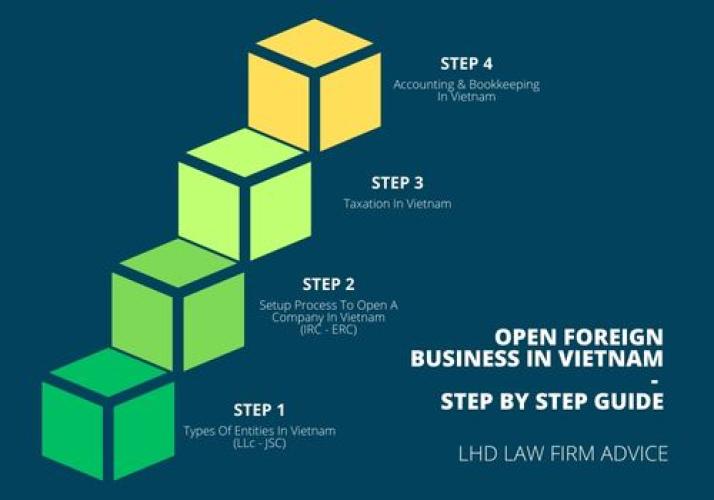
A foreign investor (just like a local investor) may select one of the following Vietnamese legal entities to carry out a project:
Learning business culture in Vietnam is the way of how to start a business in Vietnam as a foreigner
It can be said that business culture is the soul of an enterprise, because it influences, even dominates, production activities, business decisions,and internal and external relationships. Here, it is possible to understand the business culture of a business as perceptions, objectives and cultural values that must be included in every activity.
Vietnam is located in the Eastern cultural region of the Southeast corner of the world; therefore, there is a typical agricultural culture that is full of characteristics of Eastern culture.
- With a businessman when he meets up with a Vietnamese partner: Let’s start the story by introducing yourself. Don't be surprised if they want to know your age. It is a way for Vietnamese people to choose their roles when they talk, due to the abundance of personal pronouns in Vietnamese.
- Gift is an extremely popular cultural expression in Vietnam. In particular, on the occasion Tet holiday of Vietnamese people, do not forget to give gifts and greeting cards to your partners and relationships here!
- Eating and drinking is an essential part of community activities and business activities in Vietnam. Dinner with local representatives or customers to help develop relationships and make your local partner
- The way Vietnamese people drink in a party is also different. If you drink alone, it is impolite. Everyone's habit is to drink only after toasting
- During the work, the Vietnamese side often said, "we will consider", "we will answer". So if you need to decide early, it's best to send all the necessary documents before the meeting. If it is a document sent to state agencies, please write it in Vietnamese!
- At the beginning of the negotiation will always be a story which do not relate to your main discussion. Don't be impatient, that's called 'creating atmosphere'! You should not mention about your lawyer because the Vietnamese people do not want to see him when negotiating and also dislike the subject from a legal perspective.
- Sometimes, Vietnamese entrepreneurs are slow to catch the business situation. It can be said that the slow attitude of rubber hours is a daily attitude in modern Vietnamese people.
You need to update on the Law on investment and the Law on enterprises in Vietnam when you have a plan to start a business in Vietnam as a foreigner
With the enactment of the Law on Investment and the Law on Enterprises 2020, Vietnam has established a legal framework to regulate investment participation and business establishment of foreign investors in Vietnam.
Thereby, it will improve the investment environment in the direction of creating a fair competitive environment while protecting national security. Based on the current law, foreign investors looking for investment opportunities in Vietnam can choose one of two options for how to start a business in Vietnam as a foreigner with foreign elements as follows:
Option 1: Request for the first investment registration certificate (whether it is a 100% foreign-invested enterprise or a joint-venture enterprise) and then carry out the procedures to apply for a Certificate of Registration Enterprise.
Option 2: Invest in the form of capital contribution, and purchase of shares in Vietnamese companies, then participate in managing the company as agreed by the parties.
Each of the above options has certain advantages and disadvantages related to the conditions, administrative procedures and governance issues when you implement investment projects in Vietnam.
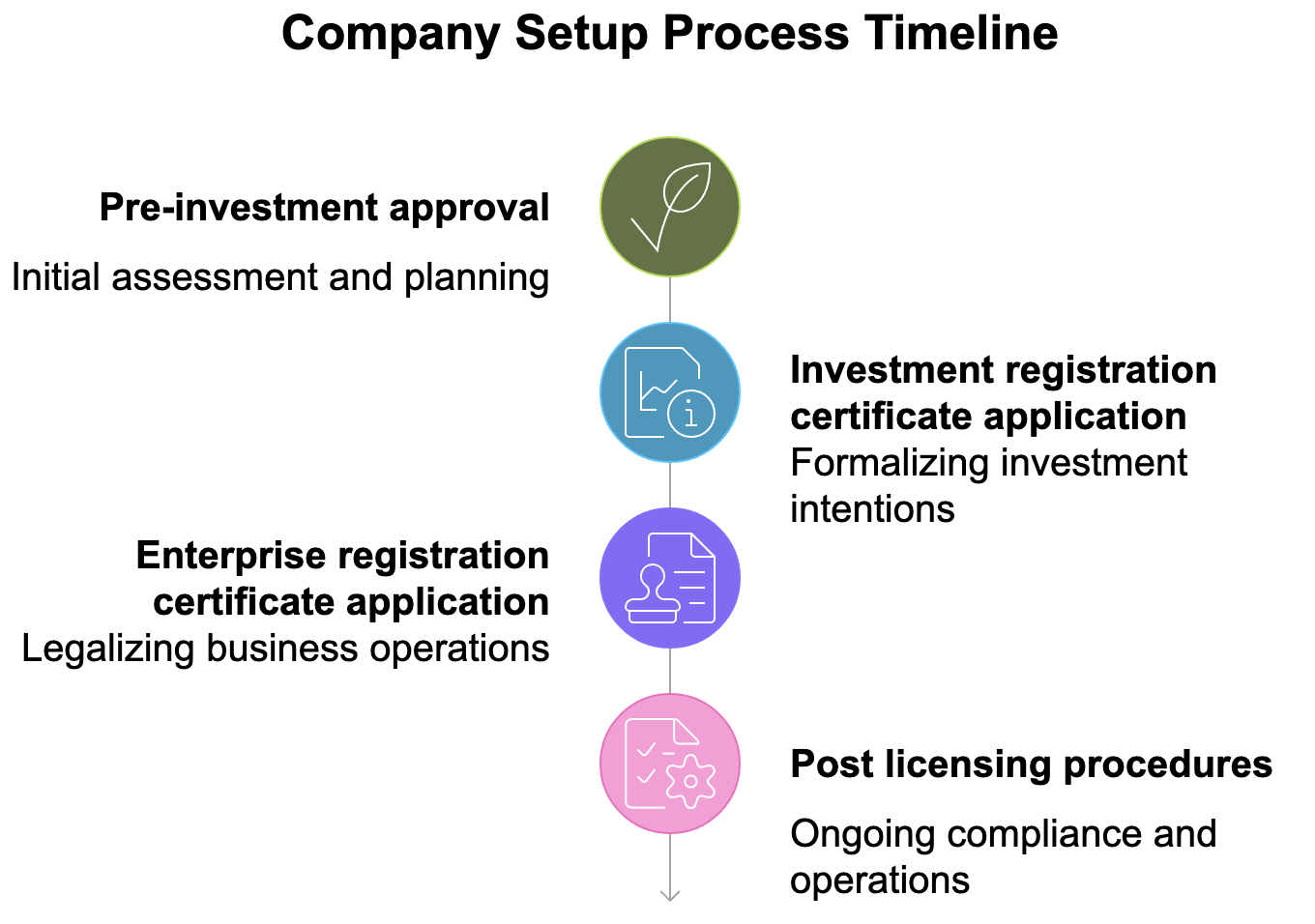
The formal process of establishing an FDI company in Vietnam involves a two-phase licensing procedure, followed by critical post-establishment steps. Understanding the requirements, timelines, and costs for each phase is essential for effective project planning.
The IRC is the foundational license for any foreign investment project. It is an approval of the project itself, granted by the state, and precedes the formation of the legal entity.
Application Dossier: A comprehensive dossier must be submitted, including:
The formal application form for the investment project.
Legal documents of the investor(s), such as the Certificate of Incorporation and company charter for a corporate investor, or a passport for an individual investor. All foreign-issued documents must be consular legalised in the investor's home country and then translated into Vietnamese by a certified translator.
A detailed investment project proposal outlining objectives, scale, capital, and implementation schedule.
Documents proving the investor's financial capacity. This typically includes audited financial statements for the last two years for corporate investors or a bank statement confirming a balance equal to or greater than the proposed contribution for individual investors.
An in-principle office lease agreement or a Memorandum of Understanding (MOU) for the proposed head office or project location.
Licensing Authority: The application is submitted to the Department of Planning and Investment (DPI) of the province or city where the project will be located. If the project is situated within an industrial zone (IZ), export processing zone (EPZ), or high-tech zone (HTZ), the application is typically handled by the management board of that zone.
Statutory Timeline: The legal processing time for an IRC application is 15 working days from the date a complete and valid dossier is received.
Once the IRC is issued, the investor can proceed to establish the Vietnamese legal entity by applying for an ERC.
Application Dossier: The key documents for the ERC application include:
The formal application for enterprise registration.
The draft Charter (equivalent to Articles of Association) of the new company.
A list of members (for an LLC) or founding shareholders (for a Joint Stock Company).
A list of the company's Ultimate Beneficial Owners (UBOs), a new mandatory requirement from July 1, 2025.
Notarized copies of the personal identification documents (e.g., passport) of the company's legal representative and all individual members/shareholders.
A copy of the newly issued IRC.
Licensing Authority: The application is filed with the Business Registration Office, a division of the provincial DPI.
Statutory Timeline: The legal processing time for an ERC is significantly shorter, at just 3 working days from the submission of a valid application.
Navigating Vietnam's capital requirements involves understanding the distinction between different capital types and the practical expectations of the licensing authorities.
Distinguishing Capital Types:
Investment Capital: This is the total fund registered in the IRC, encompassing both the investor's equity (charter capital) and any planned debt financing (loans) for the project.
Charter Capital: This is the equity portion of the investment capital that investors commit to contribute. It is recorded in the ERC and must be fully paid within 90 days of the ERC's issuance. The amount of charter capital also determines the annual business license tax rate.
Legal Capital: For certain conditional business lines (e.g., banking, insurance, securities, real estate), the law prescribes a minimum amount of charter capital that the company must have. This is known as legal capital.
Determining a "Reasonable" Capital Level: For the majority of business lines that do not have a specific legal capital requirement, the law does not set a minimum capital amount. However, this does not mean investors can register a nominal amount. The DPI will assess the "reasonableness" of the proposed charter capital in relation to the business plan, projected operational expenses, and the scale of the project. A capital amount deemed insufficient to sustain the business may lead to questions or delays in the approval process.
Practical Advice: As a general guideline, investors should register a charter capital amount sufficient to cover projected operational expenses for at least the first 12 to 24 months. While it is technically possible to register a services company with as little as US3,000,acapitalofatleastUS10,000 is often recommended. This amount is generally accepted by authorities as credible for a serious business venture and can also facilitate the subsequent application for long-term visas or temporary residence cards for the foreign investor.
The statutory timelines for licensing are often shorter than the practical reality. A realistic assessment of the time and cost involved is crucial for effective project management.
The following table provides a more realistic timeline that accounts for necessary preparatory work and potential administrative delays.
| Step | Activity | Statutory Timeline | Practical Timeline | Key Considerations & Dependencies |
| 1 | Pre-Application Preparation | N/A | 2 - 4 weeks | This phase includes document collection, consular legalisation, certified translation, office location search, and drafting the project proposal. The legalisation process can be a significant bottleneck. |
| 2 | IRC Application & Issuance | 15 working days | 4 - 6 weeks |
This assumes a complete and valid dossier. The authorities may request additional information or clarification, which can reset the processing clock. |
| 3 | ERC Application & Issuance | 3 working days | 1 - 2 weeks |
This step is generally straightforward once the IRC has been successfully obtained. |
| 4 | Post-Licensing Procedures | N/A | 2 - 4 weeks |
This includes carving the company seal, opening bank accounts, initial tax and labor registrations, and VNeID registration for the legal representative. |
| Total | End-to-End Process | ~4 weeks | 2 - 4 months | The total time is highly dependent on the complexity of the project, the investor's home country's legalization procedures, and the thoroughness of the initial application. |
It is essential to distinguish between the minimal government fees and the more substantial ancillary and professional service costs that constitute the true cost of establishment.
| Cost Category | Item | Estimated Cost (USD) | Notes |
| I. Government Fees | ERC Application Fee | ~$2 (VND 50,000) |
This fee is often waived if the application is filed online. |
| Publication Fee | ~$4 (VND 100,000) |
A mandatory fee for publishing the new company's registration details on the National Business Registration Portal. |
|
| Business License Tax | $85 - $130 / year |
An annual tax paid by all businesses. The rate depends on the registered charter capital (VND 2-3 million). |
|
| II. Ancillary Costs | Document Translation & Notarization | $200 - $600+ |
The cost depends on the number and length of the investor's corporate documents that need to be translated and notarised. |
| Consular Legalization | $100 - $400+ |
This is required for all foreign-issued corporate documents and must be done in the investor's home country. Fees vary by embassy/consulate. |
|
| Office Rental (Initial Deposit) | $500 - $1,500+ |
A registered physical address is mandatory. Virtual office services are a lower-cost option for some non-manufacturing sectors. |
|
| III. Professional Service Fees | Legal & Advisory Services | $3,000 - $10,000+ |
Fees for a law or consulting firm to manage the entire IRC/ERC application process. The cost varies significantly based on the firm's reputation and the project's complexity. |
| Total Estimated Initial Outlay | $4,000 - $12,000+ | This estimate excludes the actual charter capital contribution. |
Receiving the ERC marks the legal birth of the company, but a series of critical post-licensing procedures must be completed immediately to make the company fully operational and ensure ongoing compliance.
Immediately after ERC issuance, the company must arrange for its official seal (company stamp) to be carved and must register the seal sample with the authorities.
Following this, the company must open its bank accounts. This is a crucial step with specific requirements for FDI enterprises. The company must open at least two types of accounts:
Direct Investment Capital Account (DICA): This is a special-purpose foreign currency or VND account that is mandatory for all FDI enterprises. It is used exclusively to receive the charter capital contribution from the foreign investor. Subsequently, all capital-related transactions, such as receiving medium/long-term loans from abroad, and repatriating profits or the original investment capital, must be processed through the DICA. Failure to use a DICA for these transactions is a common and serious compliance violation that can lead to legal risks when transferring funds abroad.
Current Account: A standard VND payment account is also required for conducting day-to-day domestic business transactions, such as paying suppliers, salaries, and taxes.
The strict regulations governing the DICA underscore its function as a primary control mechanism for the State Bank of Vietnam to monitor foreign capital flows. It is more than a simple bank account; it is a regulatory gateway. Any procedural error, such as attempting to contribute capital through a regular payment account, can freeze a company's ability to be properly funded and prevent investors from legally receiving returns on their investment.
Vietnamese law mandates that investors contribute their registered charter capital in full within 90 days from the date the ERC is issued. This contribution must be transferred from the overseas bank account of the investor directly into the newly opened DICA of the Vietnamese company. This deadline is strict and non-negotiable. Failure to contribute the capital on time can result in administrative sanctions, including significant fines and, in severe cases, the potential revocation of the company's IRC and ERC.
The ERC number also serves as the company's tax identification number. Upon establishment, the company must complete several initial tax-related procedures:
Digital Signature and E-invoicing: The company must purchase a digital signature token (also known as a USB token or digital certificate). This is required for electronically signing and submitting tax returns and other official documents online. The company must also register with the tax authorities to use electronic invoices (e-invoices) for all its sales transactions.
Business License Tax: The company must make its first annual payment of the Business License Tax. The deadline for this payment depends on the date of establishment.
To legally hire employees, the new company must register with the local labour authorities, typically by submitting a declaration of labour usage. Concurrently, the company must register with the social insurance agency. This registration is mandatory for making compulsory contributions for all Vietnamese employees under labour contracts, which include social insurance, health insurance, and unemployment insurance.
FDI enterprises are subject to a complex and rigorous system of periodic reporting to various government agencies. Failure to comply can result in fines and increased scrutiny. Key reporting requirements include :
Investment Reports: The company must submit quarterly and annual reports to the DPI (or zone management board) detailing the implementation progress of its investment project. These reports cover aspects like capital disbursement, revenue, employee numbers, and technology usage.
Financial Reports: Annually, the company must have its financial statements audited by a licensed auditing firm in Vietnam. The audited report must then be submitted to the local tax authority, the DPI, and the statistics office within 90 days of the end of the financial year.
Labour Reports: Semi-annual and annual reports on labour utilisation, including details on employee numbers and changes in the workforce, must be submitted to the local labor department.
Sector-Specific Reports: Depending on the company's registered business lines, additional periodic reports may be required. For example, companies with a trading license must submit an annual report to the Department of Industry and Trade.
The post-July 2025 landscape is defined by two new, non-negotiable compliance mandates that fundamentally increase transparency and digitize corporate administration: Ultimate Beneficial Ownership disclosure and the VNeID e-identification system.
Driven by FATF recommendations, the amended Law on Enterprises introduces a mandatory UBO reporting regime to combat money laundering and enhance corporate transparency.
Defining the Beneficial Owner: The law establishes a clear, two-pronged test to identify the UBO, who must be a natural person (an individual).
Ownership Test: An individual is considered a UBO if they directly or indirectly own at least 25% of the company's charter capital or voting shares. The concept of indirect ownership requires companies to trace ownership through intermediary legal entities to the ultimate individual owner.
Control Test: An individual is also considered a UBO if they exercise ultimate control over the company's key decisions, regardless of their ownership percentage. This includes the power to appoint or dismiss key management (e.g., directors, legal representative), amend the company charter, or decide on a restructuring or dissolution.
Disclosure Procedures:
New Companies: From July 1, 2025, all new companies must include a list of their identified UBOs as a mandatory component of their initial ERC application dossier.
Existing Companies: Companies established before this date are required to declare their UBO information the next time they file for any amendment to their business registration information (e.g., changing an address or legal representative).
Ongoing Obligation: The duty is continuous. Companies must notify the business registration authority of any changes to their UBOs within 10 working days of the change occurring. This information must be archived for at least five years after the company is dissolved.
Strategic Implications: The UBO disclosure requirement represents a significant challenge to traditional investment structures that have relied on opacity. The explicit mandate to identify the ultimate individual controller, combined with the government's unrestricted access to this data for enforcement purposes, effectively undermines the viability of "disguised" ownership or nominee arrangements. Such structures have often been used to navigate foreign ownership limits in restricted sectors. Investors utilising complex offshore vehicles or informal nominee agreements now face a much higher risk of scrutiny and potential regulatory action.
As part of its national digital transformation agenda, Vietnam now requires all legal entities to use a verified digital identity for official interactions.
The Requirement: Effective July 1, 2025, all companies must register for and use a corporate electronic identification (e-ID) account to conduct online administrative procedures. This includes essential functions like tax filing, customs declarations, and accessing the National Public Service Portal. Existing corporate accounts on these portals will become invalid after this date, making the new e-ID indispensable for operations.
The Registration Process: The process creates a direct link between the company and its leadership. A corporate e-ID can only be registered by the company's legal representative (or a duly authorised employee) using their own personal Level 2 VNeID account.
The Foreign Legal Representative Challenge: This process presents a significant and immediate challenge for FDI companies led by foreigners.
Eligibility and Procedure: Foreign nationals holding a valid Temporary Residence Card (TRC) are eligible to apply for a personal Level 2 VNeID. The application requires an in-person visit to the provincial immigration office to provide biometric data (fingerprints and a digital photograph) along with their original passport and TRC.
The Implementation Bottleneck: The system for registering foreigners was officially launched on July 1, 2025. Recognising the logistical challenge, the government has initiated a "campaign" period running until August 19, 2025, to accelerate registrations, to have the system fully operational by that date. The critical issue is that until a foreign legal representative successfully obtains their personal Level 2 VNeID, the company they lead
cannot register its mandatory corporate e-ID.
Interim Solution: Tax authorities have unofficially indicated that companies may temporarily continue using their existing online tax filing accounts until the VNeID issuance process for foreigners is stabilised. However, this is a temporary workaround for a single administrative function and does not resolve the broader legal requirement.
The VNeID mandate creates a critical path dependency that could stall a new FDI company's ability to operate. The required sequence is rigid and linear: the foreign legal representative must first secure a TRC, then use it to register for a personal Level 2 VNeID, and only then can the company register its corporate e-ID. A delay at any point in this chain has a cascading effect, potentially causing the company to miss statutory deadlines for tax filing and other obligations, leading to penalties. Any new FDI company established in mid-2025 with a foreign legal representative is therefore in a race against time, its operational compliance entirely dependent on the successful and timely rollout of a brand-new government IT system for foreigners.
These two new requirements—UBO disclosure and VNeID—should be viewed as twin pillars of a new, more robust enforcement regime. They are not merely about digitization or transparency for its own sake. The UBO data provides authorities with a clear map of ultimate control, while the VNeID system creates a verified, unforgeable digital link between the actions of the company and the individual legally responsible for them. This allows government agencies to cross-reference ownership data with authenticated transactions, creating a highly auditable trail of corporate activity. It significantly lowers the barrier for assigning personal liability and enforcing regulations related to tax compliance, capital contributions, and adherence to market access conditions, fundamentally raising the stakes for corporate governance in Vietnam.
Navigating Vietnam's modernised but more complex investment landscape requires proactive planning and a deep understanding of the new compliance imperatives. The following recommendations are designed to help prospective investors mitigate risks and capitalise on the opportunities presented by the post-July 2025 framework.
A systematic approach is essential. Investors should follow a clear checklist:
Pre-Investment Due Diligence:
Conduct rigorous internal due diligence to identify every Ultimate Beneficial Owner (UBO) according to both the 25% ownership and the control tests.
Thoroughly vet the chosen business sector against Vietnam's list of conditional business lines and relevant FTA commitments (CPTPP/EVFTA) to confirm market access and foreign ownership limits.
Document Preparation:
Initiate the consular legalisation process for all required foreign corporate documents as early as possible, as this is often the most time-consuming step.
Ensure the financial capacity proof is robust and clearly demonstrates the ability to fund the proposed charter capital.
Licensing Phase:
Submit a complete and meticulously prepared IRC application to minimise requests for clarification from the authorities.
Upon receiving the IRC, immediately prepare and file the ERC application, including the mandatory new list of UBOs.
Immediate Post-Licensing Actions (First 90 Days):
Carve the company seal and open the Direct Investment Capital Account (DICA) and a local currency current account.
Ensure the foreign legal representative applies for their Temporary Residence Card (TRC) immediately upon arrival.
As soon as the TRC is issued, the legal representative must complete the in-person registration for their personal Level 2 VNeID account.
Use the newly acquired personal Level 2 VNeID to register the company's mandatory corporate e-ID account.
Transfer the full charter capital into the DICA well before the 90-day deadline.
Complete initial tax, labour, and insurance registrations.
VNeID Risk Mitigation: The most acute short-term risk is operational paralysis due to delays in VNeID registration for a foreign legal representative. To mitigate this, companies should consider appointing a trusted Vietnamese national as a second legal representative during the initial establishment phase. This allows the company to register its corporate e-ID immediately using the Vietnamese representative's existing VNeID, ensuring that critical functions like tax filing can proceed without delay while the foreign representative completes their registration process.
UBO Compliance Risk: For investors with complex, multi-layered ownership structures (e.g., private equity funds, trusts), it is crucial to seek a formal legal opinion to accurately identify all individuals who meet the UBO criteria under Vietnamese law. Given the government's clear intent, the use of nominee shareholding structures, particularly in sectors with foreign ownership restrictions, should be avoided as they now carry a significant risk of being deemed non-compliant.
Capital Contribution Risk: The 90-day capital contribution deadline should be treated as absolute. Investors must account for potential delays in international bank transfers and ensure funds are dispatched with ample time to meet the deadline.
For investors operating in prioritised sectors like semiconductors, AI, data centres, or other innovative technologies, the new laws offer unprecedented opportunities.
To qualify for special incentives, investment proposals should be explicitly structured to meet the qualifying criteria, such as the VND 6,000 billion capital threshold and the five-year disbursement plan.
Investors in these fields should actively leverage the new "fast-track" provision that allows for the establishment of the legal entity before the IRC is granted. This can significantly accelerate project timelines, allowing for earlier hiring, contracting, and operational setup.
The legislative changes of 2025 mark a clear maturation in Vietnam's approach to foreign investment. The new landscape can be characterised by a policy of "strategic friction." The government is intentionally increasing the compliance and transparency requirements to create friction for low-value, non-transparent, or technologically lagging investments. Simultaneously, it is removing friction and rolling out the red carpet for the high-quality, strategic FDI it seeks to attract.
Vietnam remains a premier destination for foreign investment, but the rules of engagement have changed. The successful investor in this new era will no longer be the one who simply brings capital, but the one who brings a commitment to high standards of corporate governance, technological advancement, and regulatory compliance. Success will be defined by the ability to prioritise robust legal frameworks from day one, to understand and align with the government's strategic economic goals, and to possess the sophistication required to operate effectively in a more digitised, transparent, and demanding administrative environment.
Meet with an attorney. We get legal advice on the type of business best suited to your situation.
Then find an office space so that your business not only has a place of business, but also a specific office address required by the government to apply for a business license. If you are not the legal representative for your business, you need to find a trusted partner.
Prepare all the necessary documents and make sure that you meet all the necessary requirements before applying for a business license. Expect a 15-day waiting period for a Vietnamese-owned company and a 60-day waiting period for a foreign company.
Running your Vietnamese business now has the ability to hire employees and enter into business contracts. There are several things you need to do, such as obtaining your company seal, applying for a tax identification number, opening a company bank account, and publicly announcing your incorporation. Periodic duties include employee tax, accounting report and insurance payments.
(In addition to legal advice, we also provide accounting services for companies with foreign capital for these companies)
Hopefully, this article will help you thoroughly about how to start a business in Vietnam as a foreigner. The above are two factors; in our opinion, it is also the two main difficulties of foreign businesses when they start their businesses in Vietnam. However, about corporate culture, you can gradually get used to but the law must be clear from the beginning. Therefore, if you want to be clearer about business laws when you start a business in Vietnam, you can contact LHD Law Firm (Free Quotation and legal advice)
A foreign investor (just like a local investor) may select one of the following Vietnamese legal entities to carry out a project:
The standard Vietnam corporate income tax (CIT) rate is 20%, though enterprises operating in the oil and gas sectors will be subject to rates between 32% and 50%;
Dividends paid by a Vietnamese company to its corporate shareholders will be completely tax exempt. Furthermore, no withholding tax will be imposed on dividends remitted to overseas corporate shareholders. For individual shareholders, the withholding tax will be 5%;
Interest payments and royalties paid to non-residents individuals or corporate entities will be subject to withholding tax of 5% and 10% respectively;
Personal income tax for residents is levied under a progressive system, ranging between 5% and 35%. However, for non-resident individuals, the tax is levied at a flat rate of 20%.
Yes, a company in Vietnam can be 100% foreign-owned in selected sectors.
Yes. As stated in Circular No: 23/2014/TT-NHNN and Circular No. 32/2016/TT-NHNN, a foreigner is considered eligible to open a bank account in Vietnam if they are permitted to stay in Vietnam and can provide the required documents:
The required documents to open a bank account in Vietnam may vary according to the bank, but will typically include:
The process to register a company involves 5 steps.
This is the standard process to register a company to operate any type of business in Vietnam. After this, depending on the nature of the business, the entity may or may not require additional sub licenses.
Foreigners are allowed to register their company in Vietnam for starting a business.
In most industries, they can own 100% of the shares of their business. In a few selected industries, company registration in Vietnam is only allowed in a joint venture agreement with a Vietnamese individual or corporate shareholder.
© 2025 LHD Law Firm

Comment